

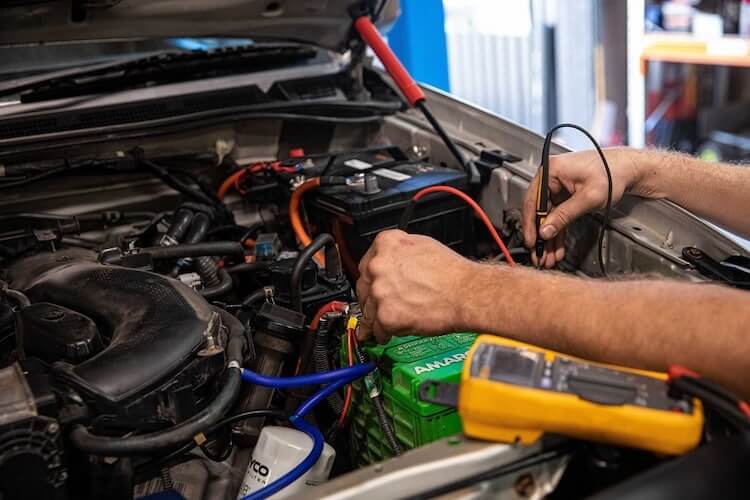
A vehicle scan tool can reveal fault codes, live sensor data, stored faults and information from electronic control modules throughout a vehicle. What it cannot reliably do is tell a technician exactly which part has failed or what needs replacing.
That distinction matters. A diagnostic scan provides clues and data, while proper vehicle diagnosis involves interpreting that information, testing the affected systems and working out what actually caused the fault.
Quick summary
- A vehicle scan tool reads information stored or reported by the vehicle’s electronic systems.
- A fault code identifies an abnormal condition, but it does not automatically identify the failed component.
- One electrical or communication fault can cause several control modules to record different fault codes.
- Professional scan tools can provide live data, actuator testing, calibrations and manufacturer-specific functions that basic code readers may not support.
- Finding the actual cause usually requires physical inspection, electrical testing and an understanding of how the vehicle’s systems work together.
What Does a Vehicle Scan Tool Do?
A vehicle scan tool communicates with the electronic control modules fitted throughout a modern vehicle. Depending on the vehicle and the diagnostic equipment being used, it can give a technician access to information that would otherwise be difficult or impossible to see.
A professional diagnostic scan tool may allow a technician to:
- Communicate with electronic control modules throughout the vehicle
- Read Diagnostic Trouble Codes, commonly called DTCs or fault codes
- View live sensor and system data
- View stored or historical faults
- Access freeze-frame or event information
- Perform actuator and output tests
- Carry out system resets and relearns
- Perform calibrations and adaptations
- Access manufacturer-specific functions
- Monitor communication between different vehicle systems
That information can be extremely useful. What it does not necessarily provide is the final answer.
Provides the clues
Shows fault codes, data, module information and test results that point the technician towards the affected system.
Finds the cause
Interprets the information, inspects the vehicle and performs further tests before deciding what actually needs repairing.
Can a Scan Tool Tell You Exactly What’s Wrong With a Car?
No. A vehicle scan tool can identify where the vehicle has detected a problem, but it does not always identify the root cause.
Imagine the vehicle stores a fault code relating to a particular sensor. It can be tempting to assume:
Sensor fault code = faulty sensor = replace sensor.
Sometimes the sensor is faulty. Sometimes it is perfectly serviceable.
The same fault could potentially be caused by:
- Damaged wiring
- A poor electrical connection
- Corrosion inside a connector
- Incorrect supply voltage
- A poor earth
- A blown fuse
- A vehicle communication network fault
- Another component supplying incorrect information
- A mechanical problem causing the sensor to report an unexpected value
- An intermittent electrical fault
- A control module or software issue
The vehicle knows that something is not behaving as expected. The technician still needs to determine why.
How a fault code becomes a diagnosis
Vehicle detects a problem
A signal or operating condition falls outside the expected range.
Scan tool reads the data
The technician reviews fault codes, live data and other available information.
Technician tests the system
Wiring, voltages, components, connections and related systems are checked.
Root cause is confirmed
The repair can then be based on evidence instead of swapping parts and hoping for the best.
What Can’t a Vehicle Scan Tool See?
A scan tool can only work with information available through the vehicle’s electronic systems. It cannot physically inspect the car.
For example, a scan tool does not know that a wiring harness was damaged during an accessory installation two years ago. It cannot see corrosion building inside a connector, notice a cable rubbing against a bracket or automatically identify wiring that somebody has previously modified.
It may also be unable to determine whether an abnormal sensor reading is caused by the sensor itself or by the mechanical or electrical system the sensor is monitoring.
This is where hands-on testing becomes necessary.
Why Can One Problem Cause Multiple Fault Codes?
One problem can create several fault codes because modern vehicle systems constantly exchange information with each other.
The engine, transmission, ABS, body control, steering, safety systems, battery management and other electronic modules can all communicate across vehicle networks.
If one module stops communicating correctly, other modules may also record faults because information they expect to receive is suddenly missing.
A diagnostic scan could therefore show a long list of fault codes even though the vehicle does not have a long list of failed components.
The technician needs to work out which fault is the cause and which faults are simply consequences of the original problem. This interconnection is also becoming increasingly relevant as newer hybrid and electric vehicles use more electronic control systems. You can read more about how these vehicles are inspected and maintained in our guide to how you service an electric car.
What Happens After a Vehicle Diagnostic Scan?
Reading the fault codes is often only the beginning of the diagnostic process. The next step is to use the information from the scan to decide what needs testing.
Depending on the fault, diagnosis may involve:
- Reviewing the stored fault codes and determining which are relevant.
- Looking at live vehicle data and comparing expected values with actual values.
- Consulting wiring diagrams and manufacturer technical information.
- Understanding how the affected system is designed to operate.
- Inspecting wiring, connectors and components.
- Testing power supplies, earths and circuit integrity.
- Using equipment such as a multimeter or oscilloscope for further electrical testing.
- Performing controlled tests through the diagnostic scan tool.
- Testing vehicle communication networks where required.
- Trying to reproduce intermittent faults under the conditions in which they occur.
- Confirming the root cause before recommending a repair.
The scan tool helps guide the process. The technician performs the diagnosis.
Why Can’t a Scan Tool Just Tell You Which Part to Replace?
Because the vehicle’s computer monitors electrical signals and operating conditions. It is not physically inspecting every component in the system.
Consider a simplified example. The engine computer expects a particular voltage from a sensor. Instead, it receives a voltage outside the expected range and stores a fault.
The computer effectively knows:
“The signal I’m receiving isn’t what I expected.”
What it may not know is why.
| Possible cause | What the vehicle may detect |
|---|---|
| Failed sensor | Unexpected sensor signal |
| Damaged wire | Unexpected or missing signal |
| Lost power supply | Sensor or component stops responding correctly |
| Poor earth | Voltage or signal outside its expected range |
| Corroded connector | Intermittent or incorrect signal |
| Actual system problem | Sensor correctly reports an abnormal condition |
Several completely different problems can therefore produce similar fault information. Testing is what separates those possibilities.
What’s the Difference Between a Basic Code Reader and a Professional Scan Tool?
A professional scan tool can usually access far more vehicle information and functions than a simple fault code reader. The exact capabilities depend on the vehicle, manufacturer and diagnostic platform being used.
| Capability | Basic code reader | Professional scan tool |
|---|---|---|
| Read common fault codes | Often | Yes |
| Access additional control modules | May be limited | Broader access depending on vehicle |
| Live data | May provide basic data | More detailed system data |
| Bidirectional controls | Usually limited or unavailable | Available on supported systems |
| Manufacturer-specific functions | Limited | Available where supported |
| Coding, calibration and adaptations | Generally limited | Available on supported vehicles and systems |
Professional equipment gives a technician more information and more ways to interact with the vehicle. That still does not turn the equipment into the technician.
In fact, the more information a modern diagnostic tool provides, the more important it becomes to understand what that information actually means.
A technician still needs to ask questions such as:
- Is that reading normal?
- Should that module be communicating?
- What should this voltage be?
- What conditions caused this fault to set?
- Which test should be performed next?
Can a Scan Tool Diagnose an Intermittent Electrical Fault?
A scan tool can provide useful evidence of an intermittent fault, but the fault may still need to be reproduced and tested before its cause can be confirmed.
Some electrical problems only appear under certain conditions. Vibration, heat, moisture, vehicle movement or a poor connection can cause a fault to appear and disappear.
The vehicle may store historical information or a fault code when the problem occurs. By the time the vehicle reaches the workshop, however, the affected circuit may be working normally again.
That can make intermittent faults much harder to isolate than a permanent failure.
Why Can Vehicle Diagnostic Time Be Difficult to Estimate?
Two vehicles can arrive with the same warning light and the same fault code but require completely different amounts of diagnostic time.
One vehicle might have an obviously damaged connector that is identified quickly. Another could have an intermittent wiring or communication problem that only occurs under specific operating conditions.
The symptom may look the same. The cause, testing process and time required to find it may be completely different.
Diagnostic time is therefore not simply the time required to plug a scan tool into the car. It includes interpreting the information, understanding the affected system, carrying out appropriate tests and methodically isolating the actual fault.
Tools, Information, Training and Experience
A vehicle scan tool is one part of modern automotive diagnosis. Effective fault-finding may also require electrical testing equipment, wiring diagrams, technical information and a solid understanding of the systems being tested.
Give someone a scan tool and you can give them a lot of information. Give that information to a trained diagnostic technician who understands how the system works and it becomes a pathway towards finding the actual fault.
That distinction is becoming more significant as vehicles use more interconnected electronics, control modules and communication networks.
Frequently Asked Questions About Vehicle Scan Tools
Can a vehicle scan tool tell you exactly what’s wrong?
No. A scan tool can show fault codes, operating data and other clues from the vehicle’s electronic systems, but further testing may be needed to determine the root cause.
Does a fault code mean the sensor needs replacing?
Not necessarily. A sensor-related fault code may be caused by the sensor, wiring, power supply, earth connection, corrosion, another vehicle system or the condition the sensor is monitoring.
Can a scan tool detect wiring problems?
A scan tool may show data or fault codes that suggest there is a wiring problem, but physical inspection and electrical circuit testing are often required to confirm it.
Can a vehicle have multiple fault codes from one problem?
Yes. Because electronic modules share information, one communication, voltage or system fault can cause several other modules to record related faults.
Can a scan tool clear fault codes?
Many diagnostic tools can clear stored fault codes on supported vehicle systems. Clearing a code does not repair the underlying problem, and the fault may return if its cause has not been fixed.
Is a professional scan tool better than an OBD2 code reader?
Professional equipment can generally provide access to more modules, live data, manufacturer-specific information, output tests, coding and calibration functions. The exact capabilities depend on the vehicle and diagnostic platform.
Is scanning a vehicle the same as diagnosing it?
No. Scanning retrieves information from the vehicle. Diagnosis involves interpreting that information, carrying out further tests and confirming what caused the fault.
Need Help Diagnosing a Vehicle Electrical Fault?
At Voltaic Auto Electrical, professional diagnostic equipment is used alongside electrical testing, technical information and hands-on fault-finding to identify the cause of vehicle electrical problems.
Voltaic owner Josh Doutch brings more than 20 years of trade experience and qualifications across both automotive electrical and mechanical fields. That experience is backed by a team that continues to develop its skills as vehicle technology changes.
If your vehicle has a warning light, intermittent electrical issue, battery drain or another fault that has been difficult to track down, learn more about our auto diagnostic services in Perth.
Don’t Just Read the Code. Diagnose the Cause.
Professional diagnostic equipment is most useful when it is backed by proper testing and someone who knows what the data actually means.