

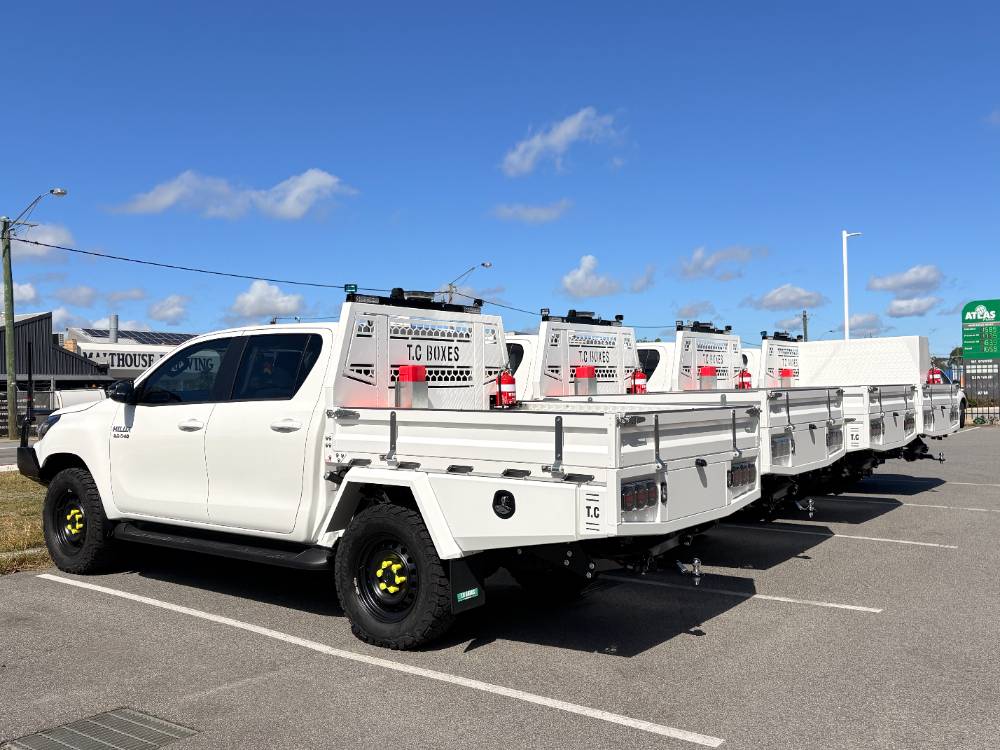
Safety equipment for mine vehicles commonly includes high-visibility lighting, reversing alarms, communication equipment, isolation systems, emergency equipment and driver visibility aids. However, there is no single mine-spec checklist that applies to every vehicle and every Australian mine site.
The equipment your vehicle needs will depend on the mine operator, site rules, vehicle type, work being completed and the risks present on site. A Hilux used for supervisor transport may have a very different fit-out from a field service vehicle working around heavy mobile plant.
Quick summary
- Mine-spec requirements vary between sites. Always obtain the current vehicle specification from the mine operator before arranging a fit-out.
- Visibility equipment commonly includes beacons, mine bars, whip flags, high-visibility markings and key-on lighting.
- Reversing safety can include reverse alarms, cameras and more advanced proximity or collision-warning systems.
- Communication equipment often includes UHF or VHF radios so drivers can communicate with other vehicles and site personnel.
- Emergency and isolation equipment can include fire extinguishers, first aid kits, wheel chocks, safety triangles and battery or starter isolators.
- Do not fit a vehicle from a generic internet checklist alone. Match the build to the vehicle, work scope and current site specification.
Is there a standard mine vehicle safety equipment checklist?
No. “Mine spec” is a general term used for vehicles prepared to meet the safety and operating requirements of a mining site, rather than one fixed Australian vehicle standard.
In Western Australia, mine operators are required to manage risks associated with mobile plant and vehicle movements. Factors such as visibility, interactions between light and heavy vehicles, reversing, braking, lighting, communication and other safety features all form part of that risk-management process.
The mine operator then develops site procedures and controls to suit the conditions of that operation. This is why two mine sites can ask for different equipment on otherwise identical vehicles.
Major operators can also have their own specifications. If you are preparing vehicles for a particular operator, check their latest requirements rather than assuming a previous vehicle will still pass. Our existing guide to mine spec vehicle requirements covers this distinction in more detail.
Before ordering equipment: Ask the site or principal contractor for its current light vehicle, mobile equipment or contractor vehicle specification. A fit-out should be built around that document, not the other way around.
What safety equipment should a mine vehicle have?
A typical site-ready vehicle will use several layers of safety equipment rather than relying on one device. The exact combination varies, but the following categories cover many of the items regularly seen on mining vehicles.
Common mine vehicle safety equipment
Visibility
Beacons, mine bars, whip flags, high-visibility tape, work lights and key-on headlights.
Reversing
Reverse alarms, reverse cameras and, where required, proximity or collision-warning technology.
Communication
UHF or VHF radio equipment, antennas and other site communication systems.
Emergency equipment
Fire extinguishers, first aid kits, wheel chocks, safety triangles and other site-specific emergency gear.
Isolation
Battery isolators, starter isolators and other electrical isolation systems specified by the site.
Monitoring
IVMS, GPS tracking, dash cameras and other monitoring equipment where required.
Why is vehicle visibility so important on mine sites?
Light vehicles can be difficult for operators of large mining equipment to see, particularly around haul trucks, loaders and other heavy mobile plant. Dust, darkness, blind spots and changing operating conditions can make the problem worse.
Mine vehicle safety equipment is therefore often designed to make a light vehicle as obvious as possible.
Depending on the site, this can include:
- flashing or rotating beacons
- buggy whips or high-mounted safety flags
- reflective or high-visibility tape
- key-on headlights that operate whenever the vehicle is running
- mine bars with elevated lighting and warning equipment
- additional work lights or driving lights
A mine bar can combine several pieces of equipment into one high-mounted unit, such as a beacon, work lights, whip flag, reverse alarm and additional indicators.
Additional vehicle lighting can also improve visibility when working in dark, remote or poorly lit areas. Our vehicle lighting installation service covers spotlights, light bars and other lighting upgrades that can form part of a site vehicle build.
What reversing safety equipment is used on mine vehicles?
Reversing alarms and cameras are common because reversing creates a risk to pedestrians, other light vehicles and mobile plant operating nearby.
An audible reverse alarm warns people nearby that the vehicle is moving backwards. Its effectiveness still depends on correct installation, maintenance and the conditions in which the vehicle is being used.
A reverse camera gives the driver additional visibility behind the vehicle. It does not replace mirrors, safe driving procedures or site traffic controls, but it can help address areas the driver may struggle to see directly.
Some sites or higher-risk applications may go further and use reversing sensors, proximity detection or collision avoidance technology.
If a camera forms part of the required build, professional reverse camera installation helps make sure the camera position, display and wiring suit the vehicle and intended use.
Do mine vehicles need UHF radios?
Many do, but the required communication system depends on the site.
Reliable communication is particularly useful where light vehicles interact with haul trucks, mobile plant, supervisors and other site personnel. Drivers may need to announce their location, request permission to enter an area or communicate with equipment operators before approaching.
A mine vehicle may be fitted with:
- UHF radio
- VHF radio
- external antenna
- site-specific radio equipment
- additional remote communication technology
The radio itself is only part of the installation. Antenna position, cable routing and power supply also matter, particularly on vehicles working in harsh conditions.
For vehicles requiring a conventional UHF setup, see our UHF radio installation service.
What emergency equipment is commonly carried?
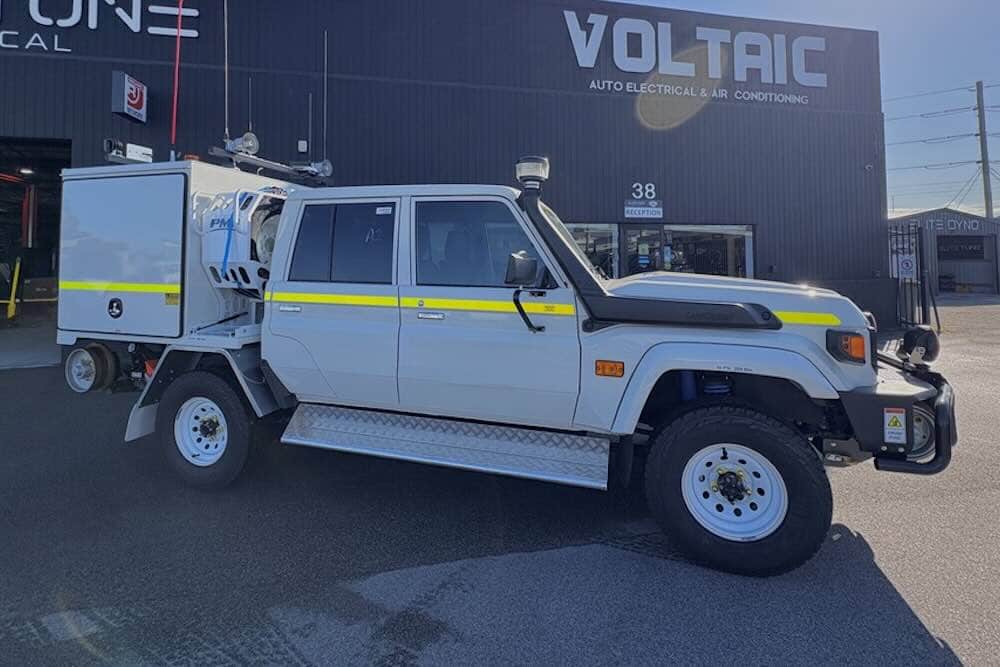
Mine and site vehicles may need equipment that allows the driver to respond to an incident or make the vehicle safe while assistance arrives.
Common examples include:
- fire extinguisher
- first aid kit
- wheel chocks
- safety triangles
- recovery equipment
- vehicle identification or asset signage
Some applications may require more specialised systems, including under-bonnet fire suppression or additional emergency equipment.
The important distinction is that these items are not automatically required in the same configuration on every mine vehicle. Size, quantity, mounting position and specification should be confirmed against the site requirements.
What are battery and starter isolators?
Isolation switches allow electrical systems to be disconnected quickly and can form part of a mine vehicle’s safety setup.
A battery isolator can disconnect the battery from electrical circuits, while a starter isolator can prevent the vehicle from being started. Some mine-spec vehicles use separate battery and starter isolation systems depending on the site specification.
These systems need to be installed so they are practical to operate, clearly identified and suitable for the vehicle’s electrical system. Modern vehicles can contain increasingly complicated electronics, so hacking an isolator into the nearest cable is not exactly the workshop masterstroke it may sound like.
What other safety equipment can a mine vehicle require?
Once the main visibility, communication and isolation equipment is covered, the specification can expand considerably.
Other equipment regularly found in site and mine vehicle fit-outs includes:
- handbrake alarms
- wheel nut indicators
- dash cameras
- GPS tracking
- IVMS equipment
- toolbox door alarms
- bullbars and rated recovery points
- towbars and towing equipment
- heavy-duty suspension
- dual battery systems
- jump-start connections
- ROPS-certified components where specified
Some of these are safety systems. Others make the vehicle more reliable, easier to monitor or better suited to its actual job.
Which equipment is common and which is site-specific?
| Equipment | Typical purpose | What to check |
|---|---|---|
| Beacon | Makes the vehicle easier to identify | Colour, mounting position and operating requirements |
| Whip flag | Improves visibility around large equipment | Required height, flag type and lighting |
| Reverse alarm | Warns people when the vehicle reverses | Alarm type and site requirements |
| UHF or VHF | Vehicle and site communication | Radio type, channels and antenna requirements |
| Battery isolator | Allows electrical isolation | Isolation arrangement and switch location |
| Fire extinguisher | Initial response to vehicle fires | Type, size, quantity and mounting |
| IVMS or GPS | Vehicle monitoring and location | Operator-approved hardware and reporting requirements |
The safest approach is to treat this table as a starting point, not a compliance certificate.
Should the equipment be checked before every shift?
Safety equipment needs to remain operational after the vehicle enters service. A beacon that stopped working three weeks ago is not much help just because it was fitted correctly on day one.
Vehicle pre-start checks should follow the mine operator’s procedures and may cover items such as:
- headlights and tail lights
- brake lights
- indicators
- reversing lights
- beacons and warning lights
- reverse alarms
- cameras
- brakes and steering
- tyres and wheels
- seatbelts
- radio equipment
- fire extinguishers and other emergency equipment
Faults should be reported and dealt with through the site’s maintenance and defect-management process. Mine vehicle safety does not finish when the keys leave the workshop.
How do you prepare a vehicle for a mine site?
Start with the site specification and work backwards. This avoids unnecessary equipment, missed requirements and the particularly enjoyable experience of paying to have something fitted twice.
From standard vehicle to site ready
Get the specification
Confirm the current requirements for the exact mine, contractor and vehicle role.
Inspect the vehicle
Check the vehicle, existing equipment and any modifications already installed.
Build to the spec
Install the required safety, lighting, communications, isolation and monitoring equipment.
Test the systems
Confirm the equipment operates correctly before the vehicle is mobilised to site.
What about BHP and other major mine operators?
Large mining companies can maintain their own vehicle specifications on top of broader legal and safety requirements.
This means a vehicle previously accepted at one operation should not automatically be assumed to meet another operator’s requirements.
For example, contractors mobilising to BHP operations should check the current BHP documentation relevant to their project and vehicle category. We have also put together a separate plain-English guide covering common BHP mine spec vehicle requirements.
The same principle applies to Rio Tinto, Fortescue and other operators. Always work from the latest documentation issued for your site.
Mine vehicle safety equipment installation in Perth
Getting the equipment list right is only half the job. It also needs to be installed properly, tested and set up for the vehicle’s actual role.
Voltaic’s team has hands-on experience with surface and underground mining equipment, along with utes, LandCruisers, service vehicles, trucks and heavy mobile equipment. Our mine spec vehicle fit-outs in Perth can include safety equipment, lighting, mine bars, UHF and VHF communications, isolation systems, cameras, IVMS, tracking, power systems and other site-specific equipment.
Whether you need one ute prepared for mobilisation or a larger fleet built to the same specification, send us the current site requirements and vehicle details. We can work out what is required and build the fit-out around the job.
FAQs about mine vehicle safety equipment
What safety equipment is required on a mine vehicle?
Requirements vary by mine site, vehicle and task. Common equipment can include beacons, whip flags, reverse alarms, radios, isolation switches, cameras, fire extinguishers, first aid kits, wheel chocks, reflective markings and vehicle monitoring systems.
Do all Australian mine sites use the same vehicle specification?
No. Mine operators can set their own vehicle and traffic-management requirements based on the risks at their operation. Always obtain the current specification for the site your vehicle will enter.
What is a mine bar?
A mine bar is a high-mounted structure used to carry safety equipment above the vehicle. Depending on the build, it may include a beacon, work lights, whip flag, reversing alarm and additional vehicle lights or indicators.
Does a mine vehicle need a reversing alarm?
Reversing alarms are commonly used on mining vehicles to warn nearby workers and vehicle operators when a vehicle is reversing. The exact alarm and installation requirements should be checked against the relevant site’s specification.
Does a mine vehicle need a UHF radio?
Many mine and site vehicles require a radio communication system, but the type depends on the operation. Some sites use UHF, while others may specify VHF or additional communication equipment.
Can a standard 4WD or ute be converted to mine spec?
Yes. Common vehicles such as Toyota HiLuxes, LandCruisers, Ford Rangers and Mitsubishi Tritons can be fitted with mine vehicle safety equipment and other accessories to meet site requirements, provided the proposed modifications are suitable for the vehicle and its intended use.