

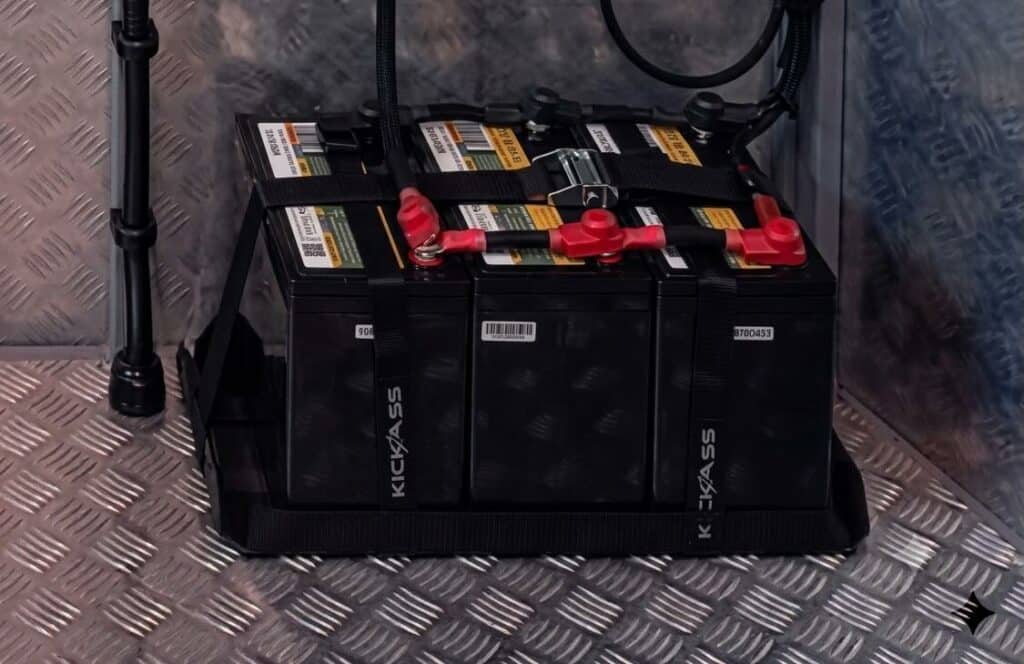
How does a battery isolator switch work? A battery isolator switch works by controlling when electrical current can flow between batteries or between a battery and a vehicle’s electrical system. In a 4WD, caravan, work ute, truck, boat, camper or fleet vehicle, it helps stop one battery from draining another. In simple terms, it lets your starting battery do its main job, which is starting the engine, while your auxiliary battery powers accessories like fridges, lights, inverters, UHF radios, pumps, tools, camping gear and other hungry little power goblins.
Battery isolator switches are common in dual battery systems because they protect the main battery from being flattened by accessories. Some are manual switches that you turn by hand. Others are automatic isolators that connect and disconnect batteries based on voltage, ignition input, charging status or a control module. The best option depends on the vehicle, battery type, alternator, accessory load and how the vehicle is used.
If your setup is simple, a manual isolator may be enough. If you drive a modern 4WD, run lithium batteries, use solar, tow a caravan or power serious accessories, you’ll usually need a smarter solution. That might be a voltage sensitive relay, solenoid isolator, ignition-controlled relay or DC-DC charger with isolation built in. Same goal. Different level of brainpower.
Quick Summary
- A battery isolator switch controls when battery power is connected or disconnected.
- Its main job is to protect the starting battery from being drained by accessories.
- In dual battery systems, it allows the auxiliary battery to run gear while keeping the starter battery ready.
- Manual isolator switches need to be physically turned on or off.
- Automatic isolators connect and disconnect based on voltage, ignition or charging conditions.
- Modern vehicles often need DC-DC chargers instead of basic isolators.
- A poor isolator setup can cause flat batteries, charging faults, cable damage or accessory issues.
- Professional installation matters because battery systems carry high current and can be dangerous when wired badly.
- Battery isolators are common in 4WDs, caravans, trucks, boats, mine spec vehicles and work fleets.
- The right isolator depends on the vehicle, alternator type, battery chemistry and power demands.
What Is a Battery Isolator Switch?
A battery isolator switch is a device that separates one battery circuit from another. It can disconnect the battery from the vehicle, disconnect an auxiliary battery from the starting battery, or isolate a battery bank for safety, storage, maintenance or emergency control.
The word “switch” can be a little confusing because not every battery isolator is a simple hand-operated switch. Some isolators are physical rotary switches. Some are relays. Some are voltage sensitive units. Some are built into a DC-DC charger. They all control electrical connection, but they do it in different ways.
In a basic vehicle setup, the starting battery powers the starter motor, ignition system, ECU, lights and standard electrical components. When the engine runs, the alternator charges the starting battery. If extra accessories are connected directly to that same battery, they can drain it when the engine is off. That is where battery isolation comes in.
A battery isolator switch separates the starting battery from accessory loads when needed. This means your fridge, camp lights or inverter can run from a second battery without stealing the juice needed to start the vehicle. Because nothing ruins a camping trip faster than turning the key and hearing absolutely nothing. Not even a polite click.
How Does a Battery Isolator Switch Work?
A battery isolator switch works by opening or closing an electrical circuit. When the isolator is closed, current can flow. When the isolator is open, current cannot flow.
Think of it like a gate in a driveway. When the gate is open, cars can move through. When it is closed, everything stays separated. In a battery system, current is the traffic. The isolator is the gate.
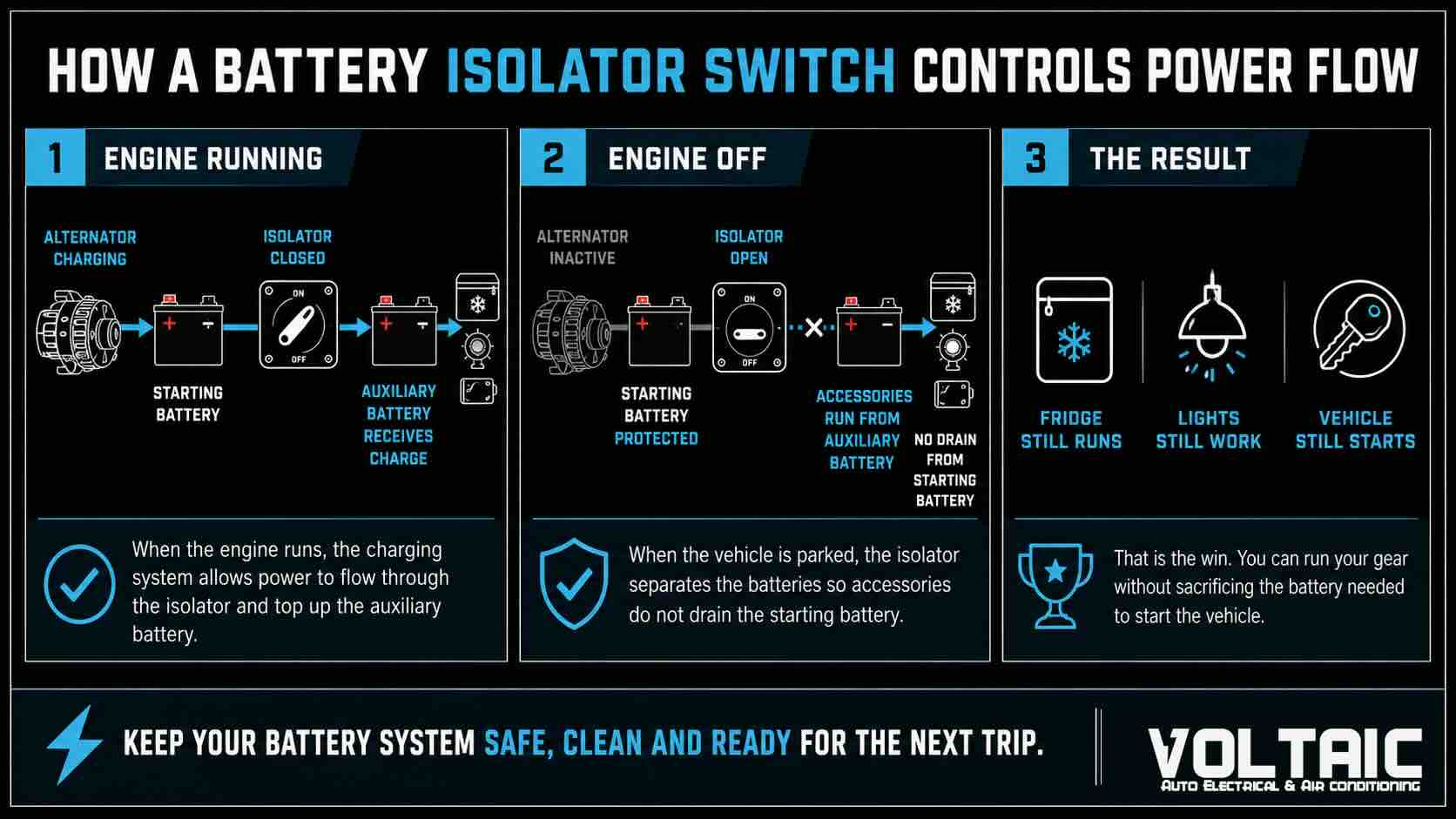
In a dual battery setup, the isolator usually sits between the starting battery and the auxiliary battery. When the engine is running and the charging system is active, the isolator allows current to flow from the alternator or starting battery circuit to the auxiliary battery. This charges the second battery.
When the engine is turned off, the isolator disconnects the two batteries. The auxiliary battery can still run accessories, but it cannot pull power from the starting battery. This is the key benefit.
Basic Current Flow
When the Vehicle Is Running:
- The alternator produces charging voltage.
- The starting battery receives charge.
- The isolator detects the charging condition or is manually switched on.
- Current flows to the auxiliary battery.
- The auxiliary battery charges while the vehicle is driving.
When the Vehicle Is Off:
- The alternator stops producing charge.
- Voltage drops.
- The isolator opens or is switched off.
- The starting battery is separated.
- Accessories continue running from the auxiliary battery only.
Why Battery Isolation Matters
Battery isolation matters because vehicle accessories can drain a starting battery faster than many people expect. A small light left on overnight can be annoying. A fridge, inverter, compressor, radio setup and camp lighting all running together can flatten a battery properly. At that point, your vehicle becomes a very expensive tent.
The starting battery is designed to deliver a large burst of power for a short time. It is not designed for long, slow accessory drain. That job is better suited to a deep cycle, AGM or lithium auxiliary battery, depending on the setup.
A battery isolator helps each battery do its own job.
The Starting Battery Handles:
- Engine cranking
- Vehicle electronics
- ECU memory
- Standard lights
- Factory systems
The Auxiliary Battery Handles:
- Fridges
- Camp lights
- Inverters
- UHF radios
- Water pumps
- Dash cameras in parking mode
- Work lights
- Tool chargers
- Starlink vehicle systems
- Camping and touring accessories
Without proper isolation, accessories may pull power from both batteries. That means you can drain the auxiliary battery and accidentally drag down the starting battery too. Not ideal when you’re parked in the bush, on a remote job site, at a boat ramp or somewhere with no one around except flies and regret.
Manual Vs Automatic Battery Isolators
Battery isolators can be manual or automatic. Both disconnect power, but they suit different use cases.
A manual battery isolator switch is controlled by the driver or operator. You physically turn it on or off. These are common in race cars, boats, heavy equipment, caravans, trailers, emergency shut-off systems and older dual battery setups. They are simple, tough and easy to understand.
An automatic isolator does the thinking for you. It connects and disconnects based on voltage, ignition status, charging input or internal electronics. These are more common in modern 4WD and touring setups because drivers do not need to remember to switch anything manually.
Here is the practical difference.
A Manual Switch Works Well When:
- You want simple battery disconnection.
- The vehicle is stored for long periods.
- The system needs a physical emergency cut-off.
- The operator understands the system.
- The setup is basic and low-tech.
An Automatic Isolator Works Better When:
- You want set-and-forget operation.
- You have a dual battery setup.
- You run accessories regularly.
- You drive a 4WD, fleet vehicle, work ute or touring vehicle.
- You do not want to manually manage charging every time you stop.
Manual switches are simple, but they rely on human memory. And humans are excellent at forgetting things five minutes after saying, “I won’t forget that.” Automatic isolators reduce that risk.
Main Types of Battery Isolators
Not all battery isolators work the same way. Choosing the wrong one can lead to poor charging, flat batteries or electrical problems. The right isolator depends on the vehicle and battery setup.
Manual Battery Isolator Switch
A manual battery isolator switch is a physical switch that opens or closes the battery circuit. It may be mounted near the battery, inside the cabin, in a tray, in a caravan storage compartment or on a machinery control panel.
When the switch is on, current flows. When the switch is off, the battery is disconnected from the connected circuit.
Manual Isolator Switches Are Often Used For:
- Battery storage disconnection
- Emergency cut-off
- Motorsport
- Marine systems
- Heavy machinery
- Caravans and trailers
- Theft deterrence
- Maintenance safety
- Simple auxiliary battery systems
The main benefit is simplicity. There are fewer electronics, fewer failure points and clear control. The downside is that the user must operate it correctly. Forget to turn it off, and you may still drain the battery. Forget to turn it on, and your auxiliary battery may not charge.
Solenoid Battery Isolator
A solenoid isolator uses an electromagnetic switch to connect or disconnect batteries. It usually works with the vehicle ignition. When the ignition is on, the solenoid closes and allows current to flow between batteries. When the ignition is off, it opens and separates them.
This was a popular dual battery method for older vehicles. It is simple and affordable. However, it can be less suitable for modern vehicles with smart alternators or sensitive electrical systems.
A solenoid can work well in some basic setups, but it may not provide the best charging profile for AGM or lithium batteries. It also does not “understand” the battery’s condition. It is basically a gate that opens when told. Strong, useful, but not exactly a genius.
Voltage Sensitive Relay
A voltage sensitive relay, often called a VSR, connects and disconnects batteries based on voltage. When the main battery voltage rises above a set point, usually because the alternator is charging, the VSR connects the auxiliary battery. When voltage drops after the engine is turned off, the VSR disconnects the batteries.
A VSR is smarter than a basic solenoid because it reacts to charging voltage. It is common in many traditional dual battery systems.
A Vsr Works Well When:
- The vehicle has a conventional alternator.
- The auxiliary battery is lead acid or AGM.
- The charging requirements are not too demanding.
- The setup is relatively simple.
However, many newer vehicles use smart alternators that reduce charging voltage to improve fuel economy and reduce emissions. In those vehicles, a VSR may not reliably detect charging voltage or may disconnect too early. That can leave the auxiliary battery undercharged.
DC-DC Charger with Isolation
A DC-DC charger is often the best option for modern dual battery systems. It controls charging properly and usually includes battery isolation as part of the system.
Instead of simply connecting the auxiliary battery to the starting battery, a DC-DC charger takes input power and charges the auxiliary battery using a controlled charging profile. This is especially useful for lithium batteries, AGM batteries, smart alternator vehicles and setups that include solar.
A Dc-Dc Charger Can:
- Isolate the starting battery
- Charge the auxiliary battery correctly
- Work with smart alternators
- Support lithium battery charging
- Accept solar input on some models
- Prevent reverse current flow
- Improve auxiliary battery performance
- Extend battery life when installed correctly
For modern 4WD touring setups, this is often the grown-up option. It costs more than a basic isolator, but it does the job properly.
Diode Battery Isolator
A diode battery isolator allows current to flow in one direction while preventing reverse current flow. In older systems, diode isolators were used to let an alternator charge multiple batteries without allowing one battery to drain another.
The downside is voltage drop. Diodes can reduce the voltage reaching the battery, which may lead to undercharging unless the system is designed to account for it. Because of this, diode isolators are less common in many modern vehicle dual battery installations.
They still exist in some applications, but for most 4WD, touring and work vehicle setups, other options are usually preferred.
Ignition-Controlled Relay
An ignition-controlled relay connects the auxiliary battery circuit when the ignition is on and disconnects it when the ignition is off. It is similar in idea to a solenoid isolator, but the relay design and current capacity depend on the system.
These setups can be useful, but they need correct wiring, fuse protection and cable sizing. A relay that is too small for the current load can overheat or fail. This is one of those areas where “she’ll be right” can turn into “why does it smell like melted plastic?”
Battery Isolator Switch Vs Battery Disconnect Switch
A battery isolator switch and a battery disconnect switch are often confused, but they are not always the same thing.
A battery disconnect switch usually disconnects a battery from the entire vehicle or circuit. It is commonly used for storage, safety, maintenance or emergency shut-off.
A battery isolator switch usually separates batteries or circuits from each other while still allowing parts of the system to function. In a dual battery system, it may allow the auxiliary battery to keep running accessories while isolating the starting battery.
The difference matters because the right switch depends on the job.
Battery Disconnect Switch Example
You have a classic car that sits in the garage for weeks. You install a battery disconnect switch so you can cut power when it is parked. This helps reduce parasitic drain and makes storage safer.
Battery Isolator Example
You have a 4WD with a fridge, camp lights and inverter. You install a dual battery system with an isolator so accessories run from the second battery while the starting battery remains protected.
Both switches isolate power. They just solve different problems.
How a Battery Isolator Works in a Dual Battery System
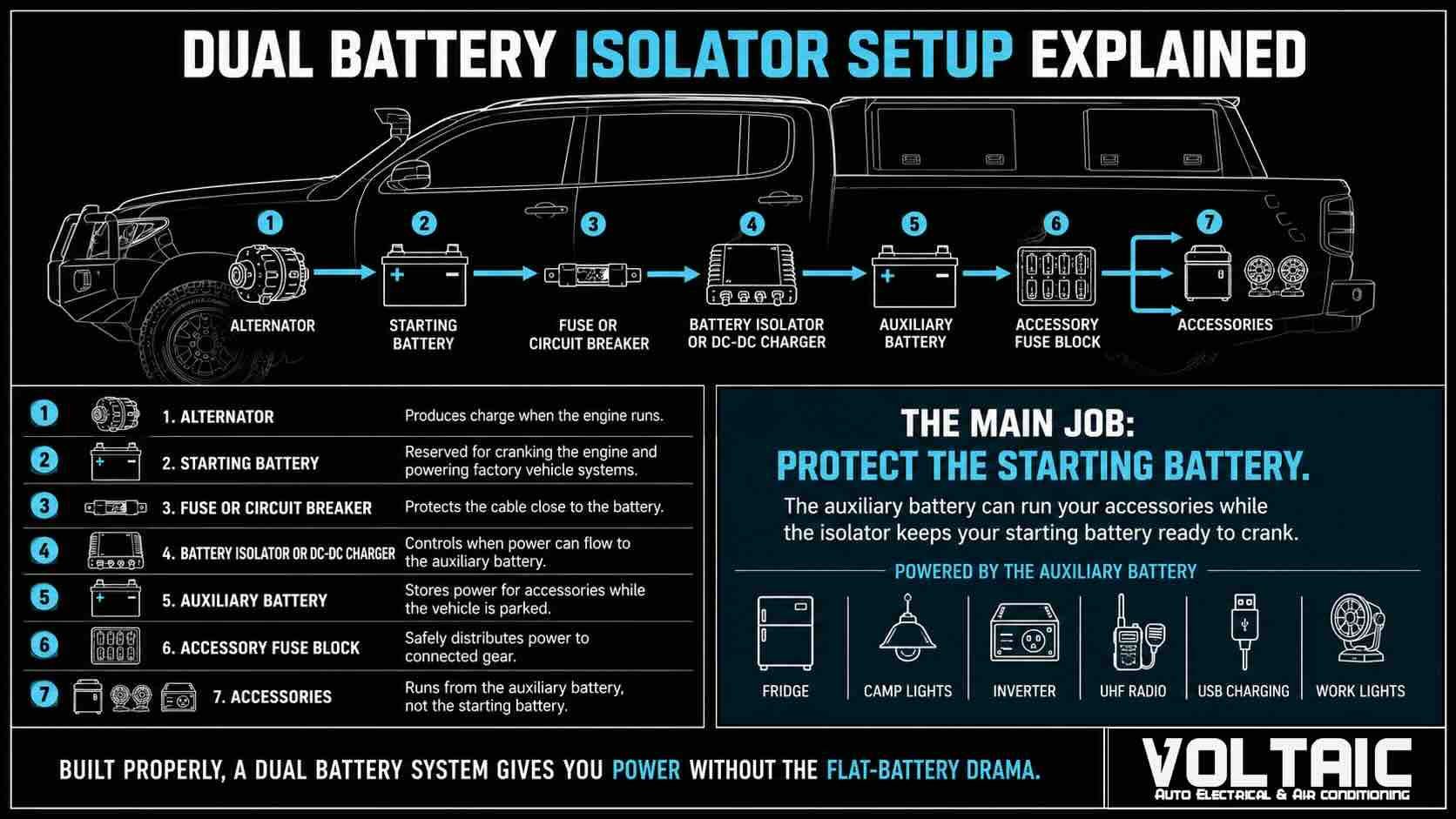
In a dual battery system, the battery isolator sits between the starting battery and auxiliary battery. Its job is to allow charging when the vehicle is running and separation when the vehicle is off.
This is a common setup:
- Starting battery under the bonnet
- Auxiliary battery in the engine bay, tub, canopy, caravan or rear cargo area
- Isolator, VSR or DC-DC charger between the two
- Fuses or circuit breakers near each battery
- Correctly sized cable between components
- Earth return through chassis or dedicated negative cable, depending on setup
- Accessories wired to the auxiliary battery
- Solar input if required
When the engine runs, the alternator charges the starting battery. The isolator allows charging current to reach the auxiliary battery. When the engine stops, the isolator separates the batteries. Accessories then draw from the auxiliary battery only.
This means you can run a fridge overnight and still start your vehicle in the morning. That is the whole point. Cold drinks and a working starter motor. We like both.
What Happens When the Engine Is Running?
When the engine is running, the alternator produces electrical energy. In a traditional charging system, this raises the system voltage above resting battery voltage. A basic lead acid starting battery may rest around 12.6 volts when fully charged. When the alternator is charging, system voltage often rises higher than this.
An automatic isolator uses that charging condition as a signal. Once the voltage rises above the isolator’s set threshold, it closes the circuit and connects the auxiliary battery. Charging current can then flow.
In a DC-DC charger system, the process is more controlled. The charger takes input from the starting battery or alternator circuit and outputs a suitable charging profile to the auxiliary battery. This is especially helpful when the auxiliary battery needs specific charging stages.
While Driving, the Auxiliary Battery Receives Charge. The Rate of Charging Depends On:
- Alternator output
- Cable size and length
- Battery chemistry
- State of charge
- DC-DC charger size
- Accessory loads running at the same time
- Solar input if fitted
- Temperature
- System design
This is why two vehicles can have “dual battery systems” but perform completely differently. One charges properly. The other limps along like a shopping trolley with one bad wheel.
What Happens When the Engine Is Off?
When the engine is turned off, the alternator stops charging. Voltage drops. The isolator then opens the circuit and separates the batteries.
This protects the starting battery. Accessories wired to the auxiliary battery can keep running, but they cannot pull current from the starting battery.
For example, say you pull up at camp and turn the engine off. Your fridge, lights and USB chargers continue running from the auxiliary battery. Overnight, the auxiliary battery drops in charge. In the morning, the starting battery is still isolated, so it should have enough power to start the engine.
Once the engine starts again, the isolator reconnects or the DC-DC charger starts charging. The auxiliary battery begins recovering.
This cycle is what makes dual battery systems so useful for touring, camping, boating, trade vehicles and fleet vehicles. It lets you use power while parked without gambling with your ability to drive away.
What Happens When the Auxiliary Battery Gets Low?
A battery isolator protects the starting battery from the auxiliary load, but it does not always protect the auxiliary battery from being drained too deeply. That depends on the rest of the system.
If accessories keep running from the auxiliary battery, they can flatten it unless there is low-voltage protection. Some fridges and inverters have low-voltage cut-off settings. Some battery management systems include protection. Some lithium batteries have a built-in battery management system. Some setups have external low-voltage disconnects.
This is an important difference.
A battery isolator protects one battery from another battery’s load. A low-voltage disconnect protects a battery from excessive discharge.
You may need both.
Deeply discharging a battery can shorten its life. This is especially true for lead acid and AGM batteries. Lithium batteries handle deeper discharge better, but they still need proper protection and charging.
If your fridge keeps cutting out overnight, your auxiliary battery may be undersized, undercharged, ageing or wired with too much voltage drop. The isolator may not be the only culprit.
Why Modern Vehicles Can Be Tricky
Modern vehicles can make battery isolation more complicated because many use smart alternators. A smart alternator does not always output a steady high charging voltage. It can vary output based on load, battery condition, engine demand, emissions strategy and ECU control.
This can cause problems for basic isolators.
A voltage sensitive relay may look for a certain voltage to connect. If the smart alternator drops voltage below that threshold, the relay may disconnect even while the engine is running. That means the auxiliary battery may not charge properly.
Modern Vehicles May Also Have:
- Battery monitoring sensors
- Stop-start systems
- ECU-controlled charging
- Regenerative charging strategies
- Sensitive electronics
- Factory warranty considerations
- Tight engine bay packaging
- Complex earthing requirements
- Lithium compatibility concerns
This is why many modern 4WDs, utes and touring vehicles are better suited to a DC-DC charger. A proper DC-DC charger can handle variable input and deliver a controlled charge to the auxiliary battery.
In other words, if your vehicle is newer, do not assume an old-school isolator setup will do the job. Modern vehicles are clever, sometimes too clever for their own good.
Battery Chemistry Matters
Battery isolator choice depends heavily on battery chemistry. Different batteries charge differently.
Lead Acid Starting Batteries
Most starting batteries are lead acid. They are designed for high-current cranking, not deep cycling. They need to be protected from accessory drain.
A basic isolator can help keep the starting battery separate from the accessory load. However, the starting battery should not be used as the main accessory battery.
Agm Batteries
AGM batteries are common in dual battery systems. They are more suitable for accessory loads than standard starting batteries, but they still need proper charging voltage and charge time.
A basic VSR can work in some AGM systems, especially with older vehicles. However, a DC-DC charger often provides better charging, especially when the battery is mounted far from the alternator or used in a smart alternator vehicle.
Lithium Batteries
Lithium batteries are popular because they are lighter, charge efficiently and offer more usable capacity. However, they need correct charging and battery management.
A basic isolator is usually not enough for a lithium auxiliary battery. Lithium batteries often need a DC-DC charger with lithium charging profile support. They may also require current limiting, temperature protection and proper fuse/cable design.
Lithium is great when done properly. Done badly, it becomes expensive confusion in a battery box.
Calcium Batteries
Some starting batteries are calcium type and may need higher charging voltage. This can influence system design. If the charging system does not suit the battery type, the battery may not charge fully.
A good auto electrician will consider the battery type before choosing the isolator or charger setup.
Battery Isolator Switch Components
A proper isolator system is more than just the isolator itself. The supporting components matter just as much.
A Well-Designed System May Include:
- Battery isolator, relay, VSR or DC-DC charger
- Correct cable size
- Correct fuse or circuit breaker rating
- Battery terminals
- Quality crimped lugs
- Heat protection
- Abrasion protection
- Mounting hardware
- Earth straps or negative cable
- Accessory fuse block
- Battery monitor
- Anderson plug if charging a trailer or caravan
- Solar input where required
- Low-voltage protection
- Labels for serviceability
Cable size is especially important. If the cable is too small, voltage drop increases and charging performance suffers. In high-current systems, undersized cable can also overheat.
Fuse placement also matters. Fuses or circuit breakers should usually be installed close to the battery positive terminals. This helps protect the cable if it shorts to earth.
The isolator is the star of the show, but the supporting cast keeps the whole thing from becoming a spicy electrical drama.
Step-By-Step: How Current Moves Through the System
Let’s walk through a typical automatic isolator setup in plain English.
Step 1: Vehicle Starts
The starting battery powers the starter motor. The isolator may still be open at this point. The auxiliary battery is not needed for cranking.
Step 2: Alternator Begins Charging
Once the engine is running, the alternator produces electrical output. The starting battery begins recovering from the cranking load.
Step 3: Voltage Rises
The system voltage rises above resting battery voltage. A voltage sensitive isolator detects this rise. A DC-DC charger detects ignition or input conditions.
Step 4: Isolator Connects
The isolator closes the circuit or the DC-DC charger starts charging. Current can now flow towards the auxiliary battery.
Step 5: Auxiliary Battery Charges
The auxiliary battery accepts charge. How fast it charges depends on system design, battery type and the charger or isolator used.
Step 6: Engine Turns Off
The alternator stops producing power. Voltage drops.
Step 7: Isolator Disconnects
The isolator opens the circuit. The starting battery and auxiliary battery are separated.
Step 8: Accessories Keep Running
The fridge, lights or other accessories run from the auxiliary battery only.
Step 9: Starting Battery Remains Protected
The starting battery should remain ready to crank the engine, provided it is healthy and the system is correctly wired.
Common Uses for Battery Isolator Switches
Battery isolator switches are used across many vehicle and equipment types.
4wds and Touring Vehicles
4WDs often use battery isolators as part of dual battery systems. These setups power fridges, camp lighting, compressors, UHF radios, inverters and other touring accessories.
For weekend adventurers, a reliable isolator setup means less stress at camp. For remote touring, it can be the difference between a good trip and a recovery bill that hurts more than a bull bar to the shin.
Caravans and Camper Trailers
Caravans and camper trailers may use isolators, DC-DC chargers and Anderson plug connections to manage charging from the tow vehicle. A good setup helps charge the caravan battery while driving without draining the tow vehicle’s starting battery while parked.
This is especially important when running fridges, water pumps, lighting and off-grid camping gear.
Work Utes and Trade Vehicles
Tradies often need battery systems for tool chargers, work lights, compressors, drawer systems, canopy lighting and inverters. A battery isolator helps keep work gear powered without risking a flat starting battery.
For a work ute, downtime is not just annoying. It can cost money, jobs and patience.
Trucks and Heavy Vehicles
Trucks and heavy vehicles may use battery isolation for safety, accessory power, serviceability and fleet management. Some systems need heavy-duty switches with high current ratings.
Heavy-duty installs need careful design because the electrical loads can be much higher than a basic passenger vehicle.
Mine Spec and Fleet Vehicles
Mine spec and fleet vehicles often need reliable battery isolation for safety, compliance, accessories, communications, lighting and site-specific equipment. These vehicles may run beacons, radios, safety systems, monitoring equipment and heavy-duty accessories.
A poor electrical setup in a fleet vehicle can create downtime across multiple vehicles. That is not a fun spreadsheet.
Boats and Marine Systems
Boats commonly use battery isolator switches to separate starting and house batteries. The starting battery handles the engine. The house battery powers lights, pumps, sounders, radios and cabin accessories.
Battery isolation is especially important on water because a flat battery offshore is more serious than a flat battery in your driveway.
Classic and Vintage Cars
Classic cars often use battery disconnect switches to prevent parasitic drain during storage. Some may also use isolator switches for safety, security or maintenance.
Signs Your Battery Isolator May Not Be Working
A faulty battery isolator can cause several symptoms. Some are obvious. Some are sneaky.
Common Signs Include:
- Starting battery keeps going flat.
- Auxiliary battery is not charging.
- Accessories stop working sooner than expected.
- Isolator clicks repeatedly.
- Battery voltage is low after driving.
- Cable or terminals feel hot.
- Fuses keep blowing.
- Fridge cuts out overnight.
- Battery warning light appears.
- Burning smell near wiring or battery area.
- Vehicle starts fine, but accessories fail.
- Auxiliary battery works only when the engine is running.
- Battery monitor shows poor charging performance.
These symptoms do not always mean the isolator itself has failed. The problem could be a blown fuse, poor earth, undersized cable, loose lug, weak battery, alternator fault, smart alternator issue or incorrect installation.
That is why testing matters. Guessing at auto electrical faults can get expensive fast. It is a bit like throwing parts at the vehicle and hoping one of them sticks.
It’s important to recruit an expert for your auto diagnostics.
How to Test a Battery Isolator Switch
Testing a battery isolator switch requires checking voltage, continuity and current flow. If you are not confident working around batteries and vehicle electrical systems, get an auto electrician involved. Batteries can deliver huge current, and a short circuit can cause burns, fire or component damage.
For a simple overview, here is what a technician may check.
Visual Inspection
The First Step Is Checking the Obvious Things:
- Loose terminals
- Corroded lugs
- Damaged cable insulation
- Burn marks
- Heat damage
- Poor mounting
- Blown fuses
- Incorrect cable routing
- Bad earth points
- Water ingress
A surprising number of faults are caused by simple connection issues. Electricity is picky. It likes clean, tight, properly sized pathways.
Voltage at Starting Battery
A healthy fully charged battery at rest may show around 12.6 volts, depending on battery type and condition. When the engine is running, charging voltage should rise.
If the starting battery voltage does not rise when the engine is running, the alternator or charging system may be the issue rather than the isolator.
Voltage at Auxiliary Battery
The auxiliary battery voltage should increase when the isolator connects or the DC-DC charger starts charging. If it does not, the isolator may not be closing, the charger may not be activating, or there may be a wiring problem.
Check Isolator Activation
For automatic isolators, a technician may check whether the isolator closes at the correct voltage or receives the correct ignition signal. For manual switches, they may check whether continuity changes when the switch is turned on and off.
Check Voltage Drop
Voltage drop testing checks how much voltage is lost through cables and connections. Excessive voltage drop can stop the auxiliary battery from charging properly.
This is especially important when the auxiliary battery is mounted in the rear of a vehicle, canopy, trailer or caravan. Long cable runs need proper sizing.
Load Testing
A system may look fine with no load but fail when accessories are switched on. Load testing helps confirm whether the circuit can handle real-world current draw.
A proper test should consider how the vehicle is actually used, not just whether the numbers look pretty for five seconds.
Safety Risks of Poor Battery Isolation
A badly installed battery isolator system can be dangerous. Vehicle batteries can produce very high current. If a positive cable shorts to the body, chassis or tray, the result can be melted insulation, sparks, battery damage or fire.
Common Safety Risks Include:
- No fuse near the battery
- Cable too small for current load
- Loose terminals
- Poor crimping
- Exposed positive connections
- Incorrect battery type
- Wrong isolator rating
- Poor cable routing near heat or sharp edges
- No grommets through metal panels
- Water-damaged components
- Inadequate ventilation for certain battery types
- Incorrect lithium charging setup
- Accessories wired directly without fuse protection
Battery isolation is not just about convenience. It is also about controlling high-current power safely.
If you are installing a system in a 4WD, work ute, truck, caravan or fleet vehicle, it is worth doing properly. A tidy install is not just about looking neat. It makes the system safer, easier to diagnose and more reliable.
Choosing the Right Battery Isolator Switch
Choosing the right battery isolator switch depends on several factors.
Vehicle Type
Older vehicles with conventional alternators may work well with simpler isolator setups. Newer vehicles with smart alternators often need DC-DC charging.
Battery Type
Lithium, AGM, calcium and lead acid batteries have different charging needs. The isolator or charger must suit the battery chemistry.
Accessory Load
A small camp light and phone charger are very different from a fridge, inverter, Starlink setup, compressor and canopy lighting. More load usually means more careful system design.
Driving Habits
If you only drive short trips, your auxiliary battery may not get enough charge from driving alone. You may need solar input, a larger DC-DC charger or a different battery setup.
Mounting Location
A battery under the bonnet faces heat. A battery in the tub or canopy may need longer cables. A caravan battery may need charging through an Anderson plug. Each layout affects cable sizing and voltage drop.
Future Upgrades
If you plan to add more gear later, it makes sense to design the system with future capacity in mind. It is usually cheaper to plan properly now than rebuild the whole system later.
Battery Isolator Switch Ratings
Battery isolator switches have current ratings. These ratings matter.
A switch must be able to handle the current passing through it. If the switch is underrated, it can overheat, fail or become a safety risk. Ratings may include continuous current and peak current. Peak current is not the same as safe continuous load.
For example, a switch may handle a high current for a short burst but not for long accessory use or charging. Always match the isolator to the system, not just the number printed in big letters on the packaging.
Important Rating Factors Include:
- Continuous current rating
- Surge or cranking current rating
- Voltage rating
- Environmental sealing
- Temperature rating
- Terminal size
- Mounting style
- Approved use case
- Compatibility with the battery system
For high-current systems, the isolator, cable, fuses and connectors all need to match. One weak link can cause problems.
Where Should a Battery Isolator Be Installed?
The location depends on the type of isolator and the vehicle layout.
Manual switches should be mounted where they are accessible but protected. In motorsport or emergency shutdown applications, they may need to be reachable quickly. In storage or marine applications, they may be mounted near the battery bank.
Automatic isolators, VSRs and DC-DC chargers are usually mounted close to the battery or in a protected area with suitable ventilation and cable routing. DC-DC chargers may need airflow because they can generate heat during operation.
Good Installation Locations Avoid:
- Direct water spray
- Excessive engine heat
- Sharp edges
- Moving parts
- Poor access
- Fuel lines
- Unprotected metal pass-throughs
- Areas where luggage or tools can damage wiring
In a 4WD canopy, for example, the auxiliary system may be mounted on a board with a battery, charger, fuse block, outlets and monitoring display. In a work ute, it may be installed inside a service body. In a caravan, it may sit in a battery compartment with solar and charging equipment.
The right location makes the system safer, cleaner and easier to service.
Can a Battery Isolator Switch Stop Parasitic Drain?
A battery disconnect switch can help stop parasitic drain by disconnecting the battery from the vehicle or accessory circuit. A battery isolator in a dual battery system can stop accessories from draining the starting battery, but it may not eliminate all parasitic draw from the vehicle itself.
Parasitic drain is the small amount of current used when the vehicle is off. Some drain is normal because vehicles need power for clocks, alarms, ECUs, keyless entry systems and memory functions. Excessive parasitic drain can flatten a battery over time.
If your vehicle battery keeps going flat while parked, a battery isolator may help in some cases, but the real fault should be diagnosed. There may be a module staying awake, a faulty accessory, poor wiring, a failing battery or an aftermarket device drawing too much current.
A Manual Disconnect Switch Can Be Useful For:
- Stored vehicles
- Classic cars
- Boats
- Machinery
- Trailers
- Race cars
- Seasonal use equipment
But on modern vehicles, fully disconnecting the battery can reset systems, affect settings or trigger faults. Get advice before fitting one to a newer vehicle.
Battery Isolator Vs DC-DC Charger
A battery isolator and a DC-DC charger are not the same thing.
A battery isolator connects or disconnects battery circuits. Its main job is separation.
A DC-DC charger manages charging. Its job is to take input power and deliver the correct charging profile to the auxiliary battery. Many DC-DC chargers also include isolation, which means they can protect the starting battery while charging the second battery properly.
For older, simple vehicles, a VSR or isolator may be suitable. For modern vehicles, lithium batteries or higher-demand touring setups, a DC-DC charger is often the better choice.
| Feature | Basic Isolator | Vsr | DC-DC Charger |
|---|---|---|---|
| Separates Batteries | Yes | Yes | Yes |
| Automatic Operation | Sometimes | Yes | Yes |
| Smart Alternator Support | Limited | Often Limited | Usually Yes |
| Lithium Support | Usually No | Usually No | Yes, if Lithium-Compatible |
| Controlled Charging Profile | No | No | Yes |
| Solar Input | No | No | Some Models |
| Best for | Simple Systems | Older Vehicles | Modern 4wds, Touring, Lithium |
If your vehicle has a smart alternator or lithium auxiliary battery, skip the bargain-bin guesswork and look at a proper DC-DC setup.
Common Battery Isolator Mistakes
Battery isolator systems fail when the design or installation does not match the vehicle.
Mistake 1: Using the Wrong Isolator
A basic isolator may not suit a modern smart alternator vehicle. The auxiliary battery may never charge properly, even if everything looks connected.
Mistake 2: Undersized Cable
Small cable creates voltage drop and heat. Long runs to the rear of a vehicle, canopy, trailer or caravan need correctly sized cable.
Mistake 3: No Fuse Protection
A positive cable connected to a battery must be protected. If it shorts without a fuse or circuit breaker, things can go bad quickly.
Mistake 4: Poor Earths
Bad earth connections cause strange faults. Accessories may work sometimes, charge poorly or fail under load.
Mistake 5: Mixing Battery Types Incorrectly
Different battery chemistries need different charging methods. Do not assume all 12V batteries can be treated the same.
Mistake 6: Ignoring Accessory Load
A small auxiliary battery may not be enough for a large fridge, inverter and camp setup. The isolator does not magically create more capacity.
Mistake 7: Mounting Components Badly
Heat, water, vibration and physical damage can kill electrical components. Mounting matters.
Mistake 8: Forgetting Future Upgrades
Many people start with a fridge, then add lights, then an inverter, then a compressor, then solar, then Starlink. Suddenly the original system is working harder than a ute with three trailers behind it.
Do You Need a Battery Isolator Switch?
You may need a battery isolator switch if you run accessories from your vehicle when the engine is off, store your vehicle for long periods, operate machinery, use a dual battery system or need a safe way to disconnect battery power.
You Should Consider Battery Isolation if You Have:
- A 4WD touring setup
- A caravan or camper trailer
- A canopy battery system
- A work ute with tool chargers
- A fridge or inverter
- A boat with start and house batteries
- A truck or machinery setup
- A classic car in storage
- Fleet vehicles with accessories
- Mine spec or heavy-duty vehicles
- Starlink or communication equipment
- Emergency lighting or work lighting
If your vehicle is stock and you do not run accessories while parked, you may not need an auxiliary battery isolator. But if you have added aftermarket gear, especially gear that runs with the engine off, isolation becomes much more important.
Can You Install a Battery Isolator Yourself?
You can install a battery isolator yourself if you have the right tools, wiring knowledge and understanding of vehicle electrical systems. But that does not mean everyone should.
A Battery Isolator Install Can Involve:
- High-current wiring
- Crimping large cable lugs
- Fuse sizing
- Cable routing through panels
- Battery chemistry selection
- Alternator compatibility
- Earth testing
- Accessory load planning
- Heat and vibration protection
- Smart alternator considerations
- Lithium battery safety
- Warranty considerations
A simple manual switch on an old trailer may be straightforward. A modern 4WD dual battery system with lithium, solar, inverter and canopy outlets is a very different job.
Poor installation can cause flat batteries, charging faults, melted wiring, blown fuses or electrical fires. If you are unsure, get it installed properly.
Battery Isolator Maintenance Tips
Battery isolator systems should be checked regularly, especially in vehicles used for touring, worksites, mining, towing or off-road driving.
Useful Checks Include:
- Inspect cables for rubbing or heat damage.
- Check battery terminals are tight and clean.
- Look for corrosion around lugs and terminals.
- Test battery voltage before and after driving.
- Confirm auxiliary battery charging performance.
- Check fuses and circuit breakers.
- Make sure manual switches move smoothly.
- Listen for repeated clicking from relays.
- Check for hot cables or connectors under load.
- Keep battery compartments clean and dry.
- Review the system after adding new accessories.
For work and fleet vehicles, electrical checks should be part of planned maintenance. This helps catch problems before they leave a vehicle dead on site.
FAQs
How Does a Battery Isolator Switch Work in Simple Terms?
A battery isolator switch works like a gate for electrical current. When it is closed, current can flow between battery circuits. When it is open, the batteries or circuits are separated. In a dual battery system, this allows the auxiliary battery to charge while driving, then disconnects it when the engine is off so accessories do not drain the starting battery.
Does a Battery Isolator Charge the Second Battery?
A basic battery isolator does not charge the battery by itself. It allows charging current from the alternator or charging system to reach the second battery. A DC-DC charger is different because it actively manages the charging process and provides a suitable charging profile for the auxiliary battery.
Will a Battery Isolator Stop My Car Battery Going Flat?
A battery isolator can stop accessories connected to an auxiliary battery from draining the starting battery. However, it will not fix every flat battery problem. If your starting battery is old, the alternator is faulty or the vehicle has parasitic drain, those issues need to be diagnosed separately.
Is a Battery Isolator the Same as a Relay?
Some battery isolators use relays or solenoids, but not all isolators are the same. A relay is an electrical switch. A battery isolator is the role or function being performed. VSRs, solenoids, manual switches and DC-DC chargers can all provide battery isolation in different ways.
Do I Need a Battery Isolator for a Dual Battery System?
Yes, most dual battery systems need some form of battery isolation. Without isolation, your accessories may drain both batteries, including the starting battery. In modern systems, isolation may be handled by a VSR, relay, manual switch or DC-DC charger.
Is a DC-DC Charger Better Than a Battery Isolator?
A DC-DC charger is usually better for modern vehicles, smart alternators and lithium auxiliary batteries because it controls the charging process. A basic isolator only connects or disconnects circuits. For simple older setups, a basic isolator or VSR may still work, but it depends on the vehicle and battery type.
Can a Battery Isolator Fail?
Yes, a battery isolator can fail. It may fail open, meaning the auxiliary battery does not charge, or fail closed, meaning the batteries remain connected when they should be separated. Wiring faults, heat, water ingress, poor installation and overloading can also cause isolator problems.
What Size Battery Isolator Do I Need?
The correct size depends on current load, cable size, battery setup, alternator output and how the system is used. The isolator must be rated for the expected current and installed with proper fuse protection. Do not choose based on price alone.
Can I Use a Battery Isolator with Lithium Batteries?
Lithium batteries usually need a lithium-compatible DC-DC charger rather than a basic isolator. This helps control charging current and voltage properly. Lithium setups should also include suitable battery management and protection.
Where Is a Battery Isolator Installed?
A battery isolator is usually installed between the starting battery and auxiliary battery. Manual switches may be mounted where they are easy to access. Automatic isolators and DC-DC chargers are usually mounted in protected locations near the battery system, depending on the vehicle layout.
Does a Battery Isolator Work with Solar?
A basic battery isolator does not manage solar charging. Solar usually needs a solar regulator or a DC-DC charger with solar input. In many touring setups, the DC-DC charger manages vehicle charging and solar input together.
Why Is My Auxiliary Battery Not Charging?
Your auxiliary battery may not be charging because of a faulty isolator, blown fuse, poor earth, undersized cable, voltage drop, smart alternator issue, failed battery or incorrect charger setup. Testing is needed to find the real cause.
Final Thoughts
A battery isolator switch works by controlling when battery circuits are connected and disconnected. In a dual battery system, it allows your auxiliary battery to charge while driving, then separates it from the starting battery when the engine is off. That simple job can save you from flat batteries, dead accessories and the classic “anyone got jumper leads?” moment.
The right setup depends on your vehicle, battery type, alternator and accessory load. Older vehicles may suit a simpler isolator or VSR. Newer 4WDs, lithium systems, caravans and high-demand touring setups often need a DC-DC charger with isolation built in.
If you are planning a dual battery system, adding accessories or dealing with battery issues, get the system checked properly. We can help design, install and diagnose battery systems for 4WDs, caravans, work utes, fleet vehicles and heavy-duty applications. Book your service or commercial vehicle fitout today and keep your ride powered, protected and ready for the next trip.