

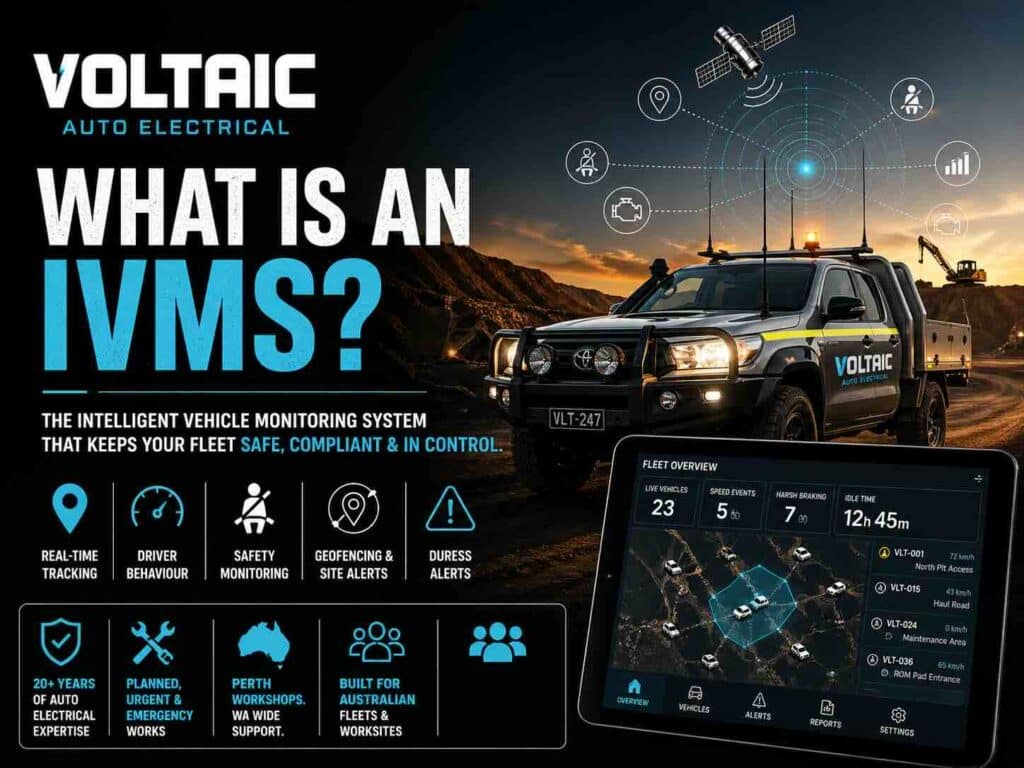
An IVMS, or In-Vehicle Monitoring System, is a vehicle monitoring and safety system used to track where a vehicle is, how it is being driven, and whether it is being operated safely. It is commonly used across mining, civil construction, transport, traffic management, utilities, remote works, and fleet operations where vehicle safety, driver behaviour, journey management, and site compliance matter.
In simple terms, an IVMS is not just a GPS tracker. GPS tells you where the vehicle is. IVMS goes further by monitoring driver behaviour, speed, harsh braking, harsh acceleration, seatbelt use, idling, journey records, geofence activity, vehicle utilisation, and safety events. In more advanced setups, it may also work alongside fatigue monitoring, driver ID, duress alerts, vehicle diagnostics, and camera systems.
For mine spec vehicles and fleet builds, IVMS is often part of a larger site-ready fit-out. It needs to be installed properly, powered correctly, configured to suit the vehicle, and matched to the relevant site or client requirements. That is where good auto electrical work matters. A tidy IVMS install does not just look better. It performs better, causes fewer headaches, and makes future servicing much easier.
Quick Summary
- IVMS stands for In-Vehicle Monitoring System.
- It tracks vehicle location, driver behaviour, safety events, speed, trip history, and vehicle use.
- IVMS is commonly used in mining, civil construction, transport, remote works, utilities, traffic management, and fleet operations.
- IVMS is more advanced than basic GPS tracking because it focuses on safety, compliance, accountability, and reporting.
- Many mine sites and major worksites require IVMS as part of vehicle access or fleet safety requirements.
- IVMS can help reduce speeding, harsh driving, unauthorised vehicle use, excessive idling, poor route compliance, and weak journey visibility.
- The right IVMS setup depends on the vehicle, work environment, site requirements, driver management needs, and reporting expectations.
- Professional installation matters because IVMS relies on clean wiring, correct power feeds, protected cabling, secure mounting, and reliable signal performance.
What Does IVMS Stand For?
IVMS stands for In-Vehicle Monitoring System. It is a system installed in a vehicle to collect, record, and report information about vehicle movement, driver behaviour, and operational safety.
The system usually combines installed vehicle hardware, GPS or GNSS location data, vehicle inputs, mobile or satellite communications, and fleet management software. Together, these components help a business see what its vehicles are doing in the real world, not just what the job sheet says they should be doing.
A simple example is a mine spec ute travelling from camp to site. A basic GPS tracker may show the ute moved from one place to another. An IVMS can show the route, time, speed, driver ID, harsh braking events, geofence entry, geofence exit, idling, and whether any driving behaviour needs attention.
That difference is why IVMS is used in higher-risk environments. It gives fleet managers and safety teams the data needed to manage vehicles properly.
How Does An IVMS Work?
An IVMS works by collecting data from the vehicle and sending it to a fleet management platform. The system usually includes a hardware unit installed in the vehicle, GPS or GNSS tracking, communication equipment, vehicle inputs, and reporting software.
The hardware records movement, speed, time, location, driving events, and other configured vehicle data. This information is then sent to an online dashboard where managers can view live locations, trip history, alerts, reports, and driver behaviour trends.
Depending on the setup, IVMS can also connect to driver ID systems, seatbelt inputs, duress buttons, fatigue monitoring, dash cameras, reverse cameras, CAN bus data, ignition inputs, or vehicle diagnostic information.
The goal is simple. IVMS turns vehicle activity into useful information. Instead of guessing where vehicles are, how they are being driven, or whether site rules are being followed, the business can see the data clearly.
The Vehicle Hardware
The IVMS hardware is usually a compact electronic unit fitted inside the vehicle. It may be installed behind the dash, under a seat, in a serviceable cabin location, or in another protected area depending on the vehicle and system design.
The unit may connect to:
- Constant power
- Ignition power
- Earth
- GPS or GNSS antenna
- Mobile or satellite antenna
- Driver ID reader
- Seatbelt input
- Duress button
- Vehicle diagnostics
- Camera or fatigue monitoring equipment
This is why IVMS installation should not be treated like a basic plug-in accessory. The system needs stable power, protected wiring, correct fusing, clean cable routing, and proper testing. If the wiring is rushed, the system can drop out, report incorrectly, drain the battery, or create faults that are painful to chase later.
The Fleet Software
The software is where the IVMS data becomes useful. It gives fleet managers, supervisors, safety teams, and business owners a way to review what is happening across their vehicles.
The dashboard can usually show:
- Live vehicle locations
- Trip records
- Driver behaviour events
- Speed alerts
- Geofence alerts
- Driver ID records
- Idle time
- Vehicle utilisation
- Incident history
- Maintenance-related data
- Safety reports
For example, a fleet manager may see that one vehicle regularly speeds on a private access road, while another spends long periods idling on site. Without IVMS, those issues may go unnoticed until there is a complaint, breakdown, incident, or blown fuel bill.
The Reporting System
Reporting is one of the biggest reasons businesses install IVMS. It gives a clear record of how vehicles are being used.
Reports may help with:
- Site compliance
- Driver coaching
- Incident reviews
- Journey management
- Vehicle utilisation
- Client reporting
- Safety meetings
- Maintenance planning
- Fleet performance reviews
For example, if a principal contractor asks for proof that vehicles are being monitored, IVMS reports can support that requirement. If a vehicle is involved in a near miss, IVMS data can help show what happened before, during, and after the event.
That is far better than relying on memory, guesswork, or the classic “yeah, nah, I was driving carefully” explanation.
IVMS Vs GPS Tracking
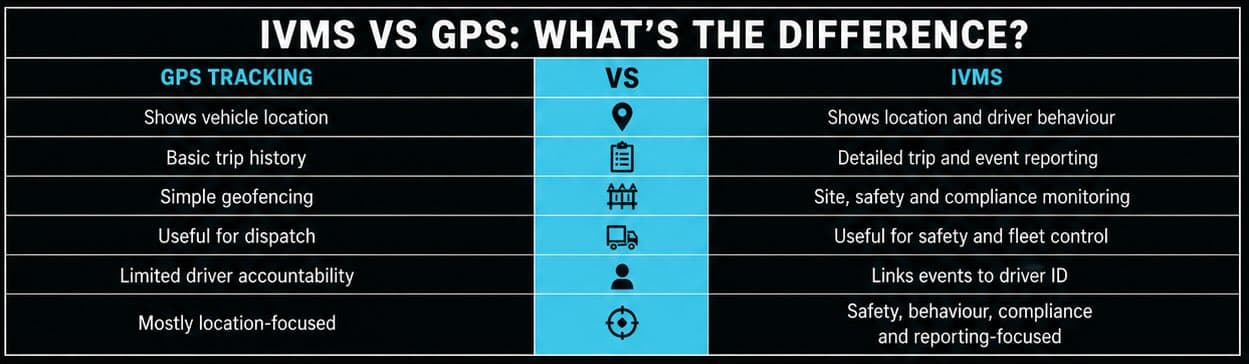
IVMS and GPS tracking are related, but they are not the same thing. GPS tracking is mainly about location. IVMS is about location, behaviour, safety, compliance, and reporting.
GPS tracking answers:
“Where is the vehicle?”
IVMS answers:
“Where is the vehicle, who is driving it, how is it being driven, what safety events occurred, and does that match our site or fleet requirements?”
That extra detail is what makes IVMS valuable for mining, construction, remote works, traffic management, utilities, transport, and any business managing vehicles in higher-risk environments.
What GPS Tracking Usually Does
GPS tracking is useful when a business needs basic visibility over vehicle movement. It can help with dispatching, job tracking, asset recovery, and route history.
GPS tracking usually covers:
- Live location
- Trip history
- Basic geofencing
- Movement alerts
- Route records
- Asset recovery
For a small metro fleet, this may be enough. If you only need to know where vehicles are during the day, a basic GPS tracker may do the job.
What IVMS Usually Does
IVMS includes vehicle tracking, but adds a stronger safety and compliance layer.
IVMS can monitor:
- Vehicle location
- Driver ID
- Trip history
- Speed events
- Harsh braking
- Harsh acceleration
- Harsh cornering
- Seatbelt use
- Idle time
- Geofence activity
- Duress events
- Journey records
- Vehicle utilisation
- Maintenance data
- Fatigue system alerts
- Camera-triggered events
This makes IVMS better suited to work environments where safety records, driver accountability, site requirements, and vehicle behaviour matter.
Why IVMS Is Used In Mining
IVMS is widely used in mining because mine sites are high-risk vehicle environments. Light vehicles, service trucks, buses, mobile plant, support vehicles, and heavy equipment often operate near haul roads, workshops, refuelling points, camp areas, loading zones, and active production areas.
That creates risk. Vehicles are moving near heavy machinery, changing road conditions, fatigue pressures, remote travel routes, and strict site controls. IVMS gives site operators and fleet managers better visibility over vehicle movement and driver behaviour.
In mining, IVMS helps monitor:
- Where vehicles are
- Whether drivers are speeding
- Whether routes are being followed
- Whether vehicles enter restricted areas
- Whether harsh driving events occur
- Whether seatbelts are being used
- Whether drivers are identified correctly
- Whether emergency alerts have been triggered
- Whether vehicle activity matches site procedures
For mine spec vehicles, IVMS is often only one part of the total fit-out. A vehicle may also need UHF radio, beacons, reverse alarm, fire extinguisher, first aid kit, wheel chocks, battery isolator, high-vis markings, reflective striping, flags, lighting, and site-specific safety equipment.
That is why the IVMS setup needs to be planned properly. The system must suit the vehicle, the site, the operator’s requirements, and the rest of the fit-out. A rushed install can create rework, failed inspections, downtime, and a very unimpressed fleet manager.
Why IVMS Matters For Fleet Safety
IVMS matters because it gives businesses real visibility over vehicle and driver behaviour. Without it, fleet safety often relies on trust, complaints, incident reports, and after-the-fact investigations. That is not ideal when vehicles are operating in high-risk environments.
With IVMS, managers can identify risky patterns before they become bigger problems. This includes repeated speeding, harsh braking, aggressive acceleration, long idle times, unauthorised vehicle use, route deviations, or unsafe driving in restricted zones.
For example, if a driver repeatedly triggers harsh braking alerts near a site entry, that could point to poor driving, a road hazard, bad traffic control, rushed scheduling, or a problem with the vehicle. IVMS gives the business a chance to investigate and act before someone bends metal or worse.
Reducing Speeding
Speeding is one of the most common issues IVMS helps control. Speed can be monitored against road limits, site limits, or custom speed thresholds set for specific areas.
This is especially useful for:
- Mine roads
- Private access roads
- Camp areas
- Workshops
- Construction zones
- Depot yards
- Remote tracks
- Civil worksites
A single speeding event may be a mistake. Repeated events show a pattern. That pattern can then be managed through driver coaching, route planning, schedule changes, or disciplinary action where needed.
Reducing Harsh Driving
Harsh braking, rapid acceleration, and aggressive cornering increase risk and vehicle wear. They can also point to poor driving habits, unrealistic scheduling, road hazards, or vehicle issues.
IVMS helps identify this behaviour clearly. Instead of relying on complaints or gut feel, managers can review event data and act on it.
For example, a traffic management fleet may have vehicles moving between live roadworks at night. If one vehicle repeatedly triggers harsh braking alerts, it may be time to review driver behaviour, route planning, vehicle load, or fatigue risk.
Supporting Fatigue Management
Fatigue is a major risk in mining, transport, regional work, and remote fleet operations. IVMS can support fatigue management by recording trip duration, vehicle movement, driving times, driver activity, and journey patterns.
When combined with fatigue monitoring or driver camera systems, IVMS can provide even stronger visibility. This can help identify fatigue-related alerts, distraction events, or repeated high-risk behaviour.
IVMS does not replace proper rostering, rest breaks, or fatigue policies. It supports them with better data.
Improving Incident Investigations
When an incident occurs, IVMS can help explain what happened. This may include vehicle speed, location, driver ID, route history, harsh events, braking, geofence activity, and timing.
That information can help businesses review incidents fairly and accurately. It can also help identify whether the issue was driver behaviour, road conditions, vehicle setup, fatigue, scheduling, or something else entirely.
Common IVMS Features
IVMS systems can be configured in different ways, but most fleet and mine-ready setups include a mix of tracking, driver behaviour monitoring, safety alerts, reporting, and vehicle data.
The right feature set depends on the vehicle, site requirements, operating environment, and level of reporting needed.
Live Vehicle Tracking
Live vehicle tracking shows where a vehicle is during operation. This helps with dispatching, emergency response, route management, site visibility, and remote work support.
For example, if a service vehicle breaks down on a remote access road, live tracking helps the team locate it faster. That matters when mobile coverage is patchy, roads are unsealed, and the nearest help is not exactly around the corner.
Trip History
Trip history records where a vehicle has travelled, when it moved, where it stopped, and how long each trip took. This helps with journey reviews, client reporting, site attendance records, and incident investigations.
A supervisor may use trip history to confirm whether a vehicle attended a site, followed the expected route, and returned to base within the planned window.
Driver Identification
Driver ID links the driver to the vehicle trip. This may use a fob, card, keypad, app, or assigned driver profile.
Without driver ID, the business may know what the vehicle did, but not who was driving. With driver ID, accountability becomes clearer.
This is especially useful when multiple workers use the same vehicle across shifts, sites, or departments.
Speed Monitoring
Speed monitoring records how fast a vehicle is travelling and flags speed breaches. Speed thresholds can often be set for different areas.
For example, a vehicle may be allowed to travel at normal road speed on public roads, but must slow down in depot yards, camp zones, private mine roads, or active work areas.
Harsh Event Detection
Harsh event detection identifies driving behaviour that may increase risk. This can include harsh braking, harsh acceleration, sharp cornering, impact events, and rollover-risk indicators depending on the system setup.
This data is useful for driver coaching and risk management. It can also help identify if certain routes, loads, or job schedules are creating unsafe driving patterns.
Geofencing
A geofence is a virtual boundary around a location. IVMS can record when a vehicle enters or leaves that area.
Useful geofences include:
- Mine sites
- Depots
- Workshops
- Refuelling areas
- Camp zones
- No-go zones
- Client sites
- Remote work areas
- High-risk road sections
Geofencing can help confirm site attendance, flag unauthorised vehicle movement, and support journey management.
Seatbelt Monitoring
Seatbelt monitoring can be configured when the IVMS is connected to the correct vehicle inputs. This helps identify whether drivers and passengers are following seatbelt requirements.
On mine sites and controlled worksites, seatbelt compliance is not optional. IVMS can help businesses monitor and enforce this behaviour.
Duress Alerts
IVMS can include duress buttons or emergency alert functions. This gives drivers a way to raise an alert when they need help.
This is especially useful for:
- Remote travel
- Mine access roads
- Regional works
- Lone workers
- Night works
- High-risk service calls
- Isolated job sites
If a driver is injured, threatened, stranded, or in trouble, a duress alert can help the business respond faster.
Idle Time Monitoring
Idle time monitoring shows how long a vehicle is running while stationary. Excessive idling wastes fuel, increases engine wear, and may point to poor site habits or inefficient work practices.
For example, if vehicles are idling for long periods while workers wait on site, the business may be able to adjust scheduling, reduce fuel waste, or change procedures.
Vehicle Diagnostics
IVMS can support vehicle maintenance when connected to vehicle diagnostic data. Depending on the setup, this may include odometer readings, engine hours, fault events, low-voltage alerts, and service-related information.
This helps businesses maintain vehicles based on real use, not just rough reminders.
Camera Integration
IVMS can work with dash cameras, fatigue cameras, and driver monitoring cameras. Camera integration can provide useful context around safety events.
For example, if a harsh braking alert is triggered, camera footage may show whether the driver was distracted, whether another vehicle cut in, or whether there was a hazard on the road.
This can make incident reviews more accurate and reduce finger-pointing.
What Data Does IVMS Collect?
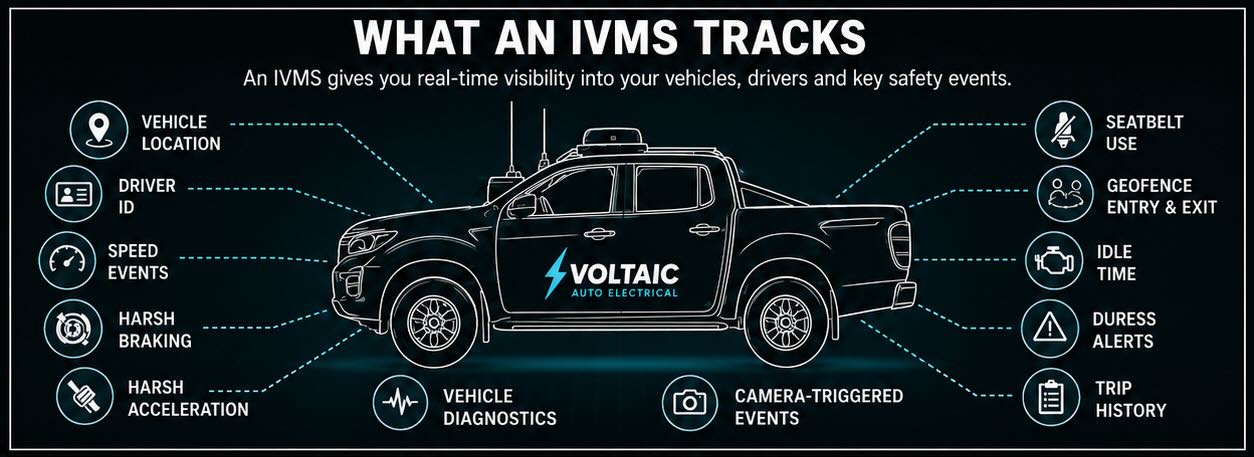
IVMS collects data that helps a business understand vehicle use, driver behaviour, and safety performance.
Common IVMS data includes:
- Vehicle location
- Vehicle speed
- Trip start and finish times
- Route history
- Driver ID
- Ignition status
- Idle time
- Harsh braking
- Harsh acceleration
- Harsh cornering
- Geofence entry and exit
- Seatbelt status
- Duress alerts
- Vehicle utilisation
- Engine hours
- Odometer readings
- Fault events
- Camera-triggered events
- Fatigue-related alerts
The exact data depends on the system, the vehicle, and how the IVMS is installed and configured.
This data should be used for safety, compliance, fleet management, and operational improvement. Drivers should be told what is being monitored, why it is being monitored, and how the data will be used. Clear communication makes the system easier to roll out and helps avoid unnecessary pushback.
Who Needs An IVMS?
IVMS is useful for any business that needs stronger visibility over vehicles, drivers, safety, and site compliance. It is especially valuable when vehicles operate in high-risk environments, remote areas, client-controlled sites, or large fleets.
Mining Contractors
Mining contractors often need IVMS because mine sites require strong control over vehicle movement and driver behaviour.
Vehicles may need to meet site requirements before they can access:
- Mine roads
- Processing areas
- Camp zones
- Workshops
- Loading areas
- Haul road interfaces
- Remote access roads
- Contractor parking areas
For mining contractors, IVMS is often part of a broader mine spec fit-out. Getting it right before mobilisation can save serious downtime.
Civil Construction Fleets
Civil construction fleets use IVMS to monitor vehicles moving between depots, worksites, road projects, plant yards, and client locations.
It helps manage:
- Driver behaviour
- Site attendance
- Vehicle movement
- Route compliance
- Safety reporting
- Idle time
- Fleet utilisation
For construction fleets, IVMS can support safer worksites and better control over vehicles that are constantly on the move.
Traffic Management Vehicles
Traffic management vehicles often operate around live roads, night works, road closures, temporary work zones, and high-pressure job schedules.
IVMS helps monitor vehicle movement, driver behaviour, site attendance, and after-hours use. It can also support reporting requirements for larger contractors and government-related projects.
Remote Service Fleets
Remote service fleets benefit from IVMS because managers need to know where vehicles are and whether drivers are travelling safely.
This includes:
- Field service technicians
- Mobile mechanics
- Auto electricians
- Remote maintenance crews
- Utility service teams
- Regional contractors
- Emergency response support vehicles
If a vehicle is travelling long distances or working away from immediate support, IVMS gives the business better visibility and faster response options.
Transport And Logistics Fleets
Transport and logistics businesses use IVMS to improve route visibility, driver safety, fuel management, vehicle utilisation, and reporting.
IVMS can help reduce speeding, unnecessary idling, route deviations, and poor driving habits. It also gives managers better data for scheduling and fleet performance reviews.
Utilities And Infrastructure Crews
Utilities and infrastructure crews often work in remote, changing, or safety-sensitive environments. IVMS helps track vehicles, support safety procedures, and monitor field operations.
This can be useful for power, water, telecommunications, road infrastructure, and emergency repair teams.
Is IVMS Mandatory?
IVMS is not mandatory for every vehicle in Australia. However, it may be required by a mine site, principal contractor, infrastructure project, company safety policy, or client contract.
The real answer is simple: it depends where the vehicle is going.
A standard work ute used around Perth may not need IVMS. A mine spec ute going to site may absolutely need it. A traffic management vehicle working under a major contract may need it. A remote service vehicle travelling across high-risk areas may need it because of internal safety requirements.
Before installing IVMS, confirm:
- The site requirement
- The client requirement
- The project specification
- The approved IVMS hardware, if specified
- The required reporting features
- Driver ID requirements
- Seatbelt monitoring requirements
- Fatigue monitoring requirements
- Camera requirements
- Duress alert requirements
- Inspection or documentation requirements
Do not assume one IVMS setup suits every site. That is how vehicles fail checks, miss mobilisation deadlines, and end up back in the workshop when they should already be earning money.
IVMS For Mine Spec Vehicles
For mine spec vehicles, IVMS is often part of a complete site-ready package. It needs to work alongside other equipment without creating electrical faults, cluttered installs, signal issues, or service access problems.
A mine spec vehicle may include:
- IVMS
- UHF radio
- Flashing beacon
- Reverse alarm
- Fire extinguisher
- First aid kit
- Wheel chocks
- Battery isolator
- Jump start receptacle
- Reflective striping
- High-vis markings
- Work lights
- Reverse camera
- Dash camera
- Dual battery system
- Site-specific signage
- Flag and pole
- Safety accessories
The key is planning the whole vehicle, not just installing one device at a time. When accessories are fitted without a clear plan, the vehicle can end up with messy wiring, overloaded circuits, poor fuse access, battery drain, and faults that are harder to diagnose later.
Our mine spec work focuses on clean, practical, site-ready fit-outs that suit how the vehicle will actually be used. Whether it is a light vehicle, service ute, support truck, or heavy-duty machine, the installation needs to be reliable, serviceable, and built for tough conditions.
For related fit-out support, see our mine spec vehicle fit out Perth service.
IVMS Installation Considerations
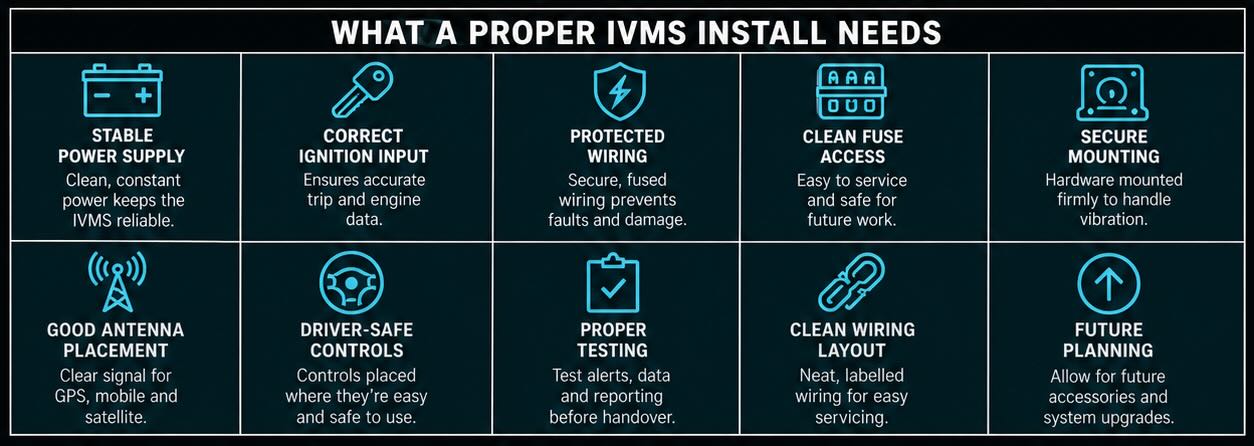
IVMS installation needs proper planning. The system must be fitted securely, powered correctly, protected from damage, and configured to suit the vehicle and work environment.
A good installation considers the full vehicle setup, not just where the hardware box can be squeezed in.
Power Supply
The IVMS unit needs reliable power. Depending on the system, it may require constant power, ignition power, earth, backup power, or connection to other vehicle circuits.
Poor power supply can cause:
- System dropouts
- Missing trip records
- False alerts
- Battery drain
- Communication issues
- Faulty reports
- Unreliable data
The power supply should be fused, protected, and installed in a way that suits the vehicle’s electrical system.
Antenna Placement
GPS, GNSS, mobile, and satellite antennas need clear signal performance. Poor antenna placement can cause weak tracking, delayed updates, inaccurate location data, or communication dropouts.
Antenna placement depends on:
- Vehicle type
- Cab design
- Roof rack setup
- Canopy layout
- Mine bar or accessory layout
- Other communication equipment
- Site operating environment
It is not just about sticking an antenna somewhere and hoping for the best. Signal performance matters.
Wiring Protection
Fleet and mine spec vehicles operate in tough conditions. Heat, dust, vibration, moisture, movement, and rough roads can all punish poor wiring.
IVMS wiring should be:
- Protected
- Secured
- Routed cleanly
- Kept clear of heat
- Kept clear of sharp edges
- Fused correctly
- Labelled where needed
- Accessible for future servicing
A neat install is not just about looking good. It reduces faults and makes life easier when the vehicle needs diagnostics, servicing, or upgrades.
Driver Access
If the IVMS includes driver ID, duress buttons, buzzers, screens, or alert devices, those components must be installed where the driver can use them safely.
They should not block controls, airbags, visibility, switches, vents, or service panels. They also need to be tough enough to handle daily use by workers who may not treat every button like it belongs in a museum.
System Testing
After installation, the system needs to be tested. This may include checking power, ignition input, GPS signal, communication, driver ID, duress alerts, geofences, seatbelt monitoring, camera triggers, and data reporting.
Skipping testing is asking for trouble. The last thing anyone wants is to find out the IVMS is not reporting correctly after the vehicle is already on site.
For broader electrical support, see our heavy duty auto electrical Perth service.
Benefits Of IVMS For Businesses
IVMS gives businesses better control over safety, vehicles, drivers, and reporting. For fleets working in mining, civil construction, transport, traffic management, and remote works, that visibility can make a real difference.
Better Driver Accountability
IVMS links vehicle use to driver behaviour. When drivers know speed, harsh events, route activity, and trip records are monitored, they are more likely to follow safe driving practices.
This is not about catching people out for the sake of it. It is about setting clear expectations and backing them with data.
Stronger Safety Management
IVMS helps safety teams identify patterns, coach drivers, review incidents, and improve procedures.
For example, if several vehicles trigger harsh braking events on the same route, the issue may not be one bad driver. It may be a road hazard, poor traffic flow, bad scheduling, or a site access problem.
IVMS helps uncover those patterns.
Easier Site Compliance
For mine sites and major projects, vehicle monitoring may be part of the access or contract requirement. IVMS can help provide the reporting and visibility needed to support compliance.
This can be useful during:
- Vehicle onboarding
- Site inspections
- Contractor reviews
- Safety audits
- Incident investigations
- Client reporting
Improved Fleet Utilisation
IVMS can show which vehicles are being used, which are sitting idle, and whether the fleet is the right size for the work.
A business may discover it has too many vehicles sitting unused, or that a small number of vehicles are doing most of the work. That data can help with fleet planning and cost control.
Reduced Fuel Waste
Speeding, harsh acceleration, poor route planning, and excessive idling all waste fuel. IVMS helps identify these issues so the business can take action.
In a large fleet, small improvements can add up quickly.
Lower Vehicle Wear
Harsh driving increases wear on brakes, tyres, suspension, driveline components, and engines. IVMS helps identify drivers or routes that may be contributing to unnecessary wear.
This supports better maintenance planning and can help reduce unexpected downtime.
Faster Emergency Response
If a driver is in trouble, IVMS can help locate the vehicle quickly. Duress alerts, live tracking, and trip records can support emergency response, especially in remote or isolated areas.
For regional WA and mine access roads, that visibility can be a serious safety advantage.
Limitations Of IVMS
IVMS is powerful, but it is not a complete fleet safety solution by itself. It works best when it is supported by good policies, proper maintenance, driver training, quality installation, and active management.
IVMS Needs Good Setup
The system needs to be installed and configured properly. If driver ID is not used correctly, geofences are poorly set, or power connections are unreliable, the data may be incomplete or misleading.
A poor setup can create more confusion than clarity.
IVMS Needs Active Management
Data only helps if someone reviews it. If alerts are ignored and reports are never checked, IVMS becomes a very expensive box with blinking lights.
Businesses should decide who reviews the data, how often reports are checked, and what actions follow repeated unsafe behaviour.
IVMS Needs Driver Communication
Drivers should know what the system records and why. If IVMS is rolled out without explanation, it can create resistance.
Clear communication helps drivers understand that IVMS is there to support safety, compliance, and fair reporting.
IVMS Does Not Replace Maintenance
IVMS can help identify maintenance-related patterns, but it does not replace proper servicing, inspections, or diagnostics. A vehicle still needs qualified technicians, regular checks, and repairs when something is not right.
For fault finding and vehicle electrical issues, see our auto diagnostics service.
IVMS And Driver Privacy
Driver privacy needs to be handled properly. IVMS collects data about vehicle movement and driver behaviour, so businesses should be clear about how that information is used.
A good IVMS policy should explain:
- What data is collected
- Why the data is collected
- Who can access the data
- How long data is stored
- How alerts are reviewed
- How incidents are investigated
- How driver coaching is handled
- Whether cameras or fatigue systems are included
- What happens if unsafe behaviour is identified
This helps protect both the business and the driver. It also avoids the “hang on, what exactly is this thing tracking?” conversation after the system is already installed.
IVMS should be used for safety, compliance, fleet management, and operational improvement. It should not be treated as hidden surveillance.
IVMS And Fleet Maintenance
IVMS can support fleet maintenance by tracking how vehicles are actually used. This can be more useful than relying only on calendar-based reminders.
For example, two vehicles may have the same age and similar kilometres, but very different usage. One may spend long hours idling on site. Another may travel mostly on sealed roads. Another may work daily on rough mine roads with heavy accessory loads.
IVMS can help track:
- Engine hours
- Odometer readings
- Idle time
- Low-voltage events
- Fault alerts
- Trip patterns
- Vehicle utilisation
- Harsh driving
- Service intervals
- Operating conditions
This helps fleet managers make better maintenance decisions. It can also highlight issues before they become major faults.
For example, repeated low-voltage events may point to a weak battery, charging issue, poor accessory setup, or parasitic drain. That is where proper auto electrical diagnostics come in handy.
IVMS For Light Vehicles
Light vehicles are one of the most common IVMS installation types. This includes utes, 4WDs, SUVs, wagons, and service vehicles used across mining, construction, civil works, traffic management, and remote operations.
Common light vehicles that may need IVMS include:
- Toyota Hilux
- Toyota LandCruiser
- Ford Ranger
- Isuzu D-MAX
- Mazda BT-50
- Mitsubishi Triton
- Nissan Navara
- Toyota Prado
- Service utes
- Mine spec support vehicles
For light vehicles, IVMS may monitor:
- Driver ID
- Speed
- Trip history
- Harsh events
- Seatbelt use
- Geofence activity
- Idle time
- Vehicle utilisation
- Route compliance
- Duress alerts
- Camera events
A mine spec ute may also need other equipment installed at the same time. Planning this properly helps avoid double handling and keeps the vehicle cleaner, safer, and easier to service.
IVMS For Heavy Vehicles
Heavy vehicles often need more robust IVMS setups because they operate under heavier loads, longer duty cycles, and higher-risk conditions.
This can include:
- Service trucks
- Water carts
- Fuel trucks
- Buses
- Prime movers
- Rigid trucks
- Crane trucks
- Maintenance trucks
- Roadwork vehicles
- Heavy fleet support vehicles
Heavy vehicle IVMS may monitor:
- Speed
- Route compliance
- Driver ID
- Harsh braking
- Harsh acceleration
- Idle time
- Engine hours
- Maintenance data
- Geofence activity
- Trip records
- Duress alerts
- Camera events
Installation also needs extra care. Heavy vehicles often have more complex electrical systems, auxiliary power, dual battery setups, multiple accessories, and harsher operating conditions. Vibration, heat, dust, and long hours can quickly expose poor workmanship.
IVMS For Mobile Plant And Machinery
IVMS and monitoring systems can also be used on mobile plant and machinery where site requirements or operational risks call for it.
This may include:
- Loaders
- Dozers
- Graders
- Drills
- Haul trucks
- Excavators
- Service equipment
- Construction machinery
- Mining support equipment
The installation environment on mobile plant is very different from a standard vehicle. The equipment may face constant vibration, heavy dust, mud, heat, moisture, and rough operating conditions.
That means the install needs to be tough. Cabling must be protected, components must be mounted securely, and the system needs to be serviceable. A loose connection on a road car is annoying. A loose connection on mobile plant in the middle of site is a proper headache.
Our heavy-duty fit-out work covers construction and mining machinery, including loaders, dozers, haul trucks, graders, and drills.
How To Choose An IVMS
Choosing the right IVMS starts with understanding what the vehicle needs to do, where it will operate, and what the site or client requires.
The best IVMS is not always the most expensive one. It is the one that matches the job properly.
Start With The Site Requirement
If the vehicle is going to a mine site, civil project, infrastructure job, or client-controlled site, check the requirement first.
Confirm:
- Approved IVMS providers
- Required hardware
- Required reports
- Driver ID requirements
- Seatbelt monitoring requirements
- Duress alert requirements
- Fatigue monitoring requirements
- Camera requirements
- Geofence needs
- Communication requirements
- Inspection documentation
This prevents wasted time and rework.
Match The System To The Vehicle
A light vehicle, heavy truck, bus, or mobile plant machine may each need a different approach.
Consider:
- Vehicle make and model
- Electrical system layout
- Accessory load
- Available mounting space
- Antenna position
- Existing equipment
- Future upgrades
- Operating conditions
A system that works neatly in a Hilux may need a different installation approach in a service truck or grader.
Match The System To The Work
The working environment matters.
Ask:
- Will the vehicle operate remotely?
- Will it work on mine roads?
- Will it be used by multiple drivers?
- Will it need driver ID?
- Will it need camera integration?
- Will it need duress alerts?
- Will it need mobile or satellite communication?
- Will it need detailed reporting?
- Will the vehicle cross multiple sites?
The more demanding the work, the more carefully the IVMS needs to be specified and installed.
Think About Reporting
Before choosing a system, work out what reports the business actually needs.
Useful reports may include:
- Speed events
- Driver behaviour
- Site entry and exit
- Trip history
- Idle time
- Vehicle utilisation
- Driver ID activity
- Safety alerts
- Maintenance triggers
Too little data is a problem. Too much noise is also a problem. The goal is useful information that helps the business act.
IVMS Installation Checklist
Before installing IVMS, it is worth checking the basics. This helps avoid missed requirements and unnecessary rework.
Use this checklist before booking an IVMS install:
- Confirm the site or client specification
- Confirm whether a specific IVMS provider is required
- Confirm the vehicle make, model, and year
- Confirm whether the vehicle is light, heavy, or mobile plant
- Confirm whether driver ID is required
- Confirm whether seatbelt monitoring is required
- Confirm whether duress alerts are required
- Confirm whether fatigue monitoring is required
- Confirm whether dash cameras or driver cameras are required
- Confirm whether mobile or satellite communication is needed
- Confirm antenna placement requirements
- Confirm power and ignition requirements
- Confirm reporting requirements
- Confirm geofence needs
- Confirm whether other accessories are being installed
- Confirm inspection or documentation needs
For fleet builds, it is smart to plan IVMS at the same time as UHF, lighting, dual batteries, reverse cameras, dash cams, Starlink, isolators, and mine spec safety gear. This creates a cleaner install and reduces double handling.
For broader fleet support, see our fleet services page.
Common IVMS Mistakes
IVMS problems usually come from poor planning, poor installation, or choosing the wrong system for the job.
Installing Before Checking Site Requirements
This is one of the most common mistakes. If a site requires a specific IVMS provider, driver ID method, camera setup, or reporting feature, installing the wrong system can lead to failed inspections and costly rework.
Always check the requirement first. The vehicle needs to suit the site, not the other way around.
Treating IVMS Like Basic GPS
A basic GPS tracker may not meet IVMS requirements. IVMS usually needs driver behaviour monitoring, safety alerts, reporting, and compliance features.
If a client asks for IVMS, do not assume a simple tracker will pass.
Poor Wiring
Bad wiring causes bad outcomes. IVMS wiring needs to be protected, secure, correctly fused, and installed with future servicing in mind.
Poor wiring can cause:
- Dropouts
- Battery drain
- False alerts
- Faulty reporting
- Damaged trim
- Electrical faults
- Failed inspections
- Painfully slow diagnostics
No one wants to pay twice because the first install looked like a bowl of noodles behind the dash.
Bad Antenna Placement
Antenna placement affects signal performance. Poor placement can cause weak GPS tracking, delayed updates, or communication dropouts.
This is especially important on vehicles with roof racks, canopies, mine bars, satellite equipment, or multiple communication systems.
Ignoring Driver Training
Drivers need to know how to use the system. This includes driver ID, duress buttons, alerts, and any in-cab equipment.
If drivers do not understand the system, data quality suffers and the business loses value.
Not Reviewing Reports
IVMS does not improve safety by sitting there quietly. Reports need to be reviewed and acted on.
Businesses should decide:
- Who checks alerts
- How often reports are reviewed
- What counts as a serious event
- How drivers are coached
- How repeated issues are handled
- How incidents are investigated
IVMS For Perth And WA Fleets
IVMS is especially relevant for Perth and WA fleets because so many vehicles support mining, civil construction, infrastructure, regional transport, traffic management, and remote service work.
A vehicle may be built in Perth, inspected in Perth, then sent to the Pilbara, Goldfields, Mid West, South West, Kimberley, Wheatbelt, or another remote site. Once that vehicle leaves the workshop, rework becomes much harder and much more expensive.
That is why the fit-out needs to be right before the vehicle heads out.
For WA fleets, IVMS can help manage:
- Mine site access
- Remote journey visibility
- Driver safety
- Site compliance
- Contractor reporting
- Vehicle utilisation
- Regional travel
- Emergency response
- Fleet accountability
- Maintenance planning
With workshops in Welshpool and Wangara, we support Perth businesses with planned, urgent, and site-ready auto electrical work. We work with fleet operators, mine spec vehicles, construction machinery, traffic management vehicles, pilot vehicles, and heavy-duty equipment.
How Much Does IVMS Cost?
The cost of IVMS depends on the hardware, system type, vehicle, installation complexity, reporting needs, and whether extra accessories are required.
There is no single price that applies to every vehicle because the scope can vary heavily. A simple light vehicle install is very different from a mine spec fit-out with driver ID, seatbelt monitoring, duress alerts, camera integration, satellite communication, and other equipment.
Cost factors include:
- IVMS hardware
- Installation labour
- Driver ID equipment
- Duress buttons
- Antennas
- Camera integration
- Fatigue monitoring integration
- Seatbelt monitoring
- Vehicle diagnostic integration
- Mobile or satellite communication
- Subscription and data costs
- Dashboard access
- Reporting features
- Site documentation
- Vehicle type
- Existing accessories
- Future upgrade requirements
For example, installing IVMS into a new fleet ute may be relatively straightforward. Installing it into a heavy service truck with multiple accessories, dual batteries, communications equipment, cameras, and mine spec requirements will naturally take more time and planning.
The safest approach is to confirm the site requirements first, inspect the vehicle setup, then quote the job properly.
Is IVMS Worth It?
IVMS is worth it when a business needs stronger control over vehicle safety, driver behaviour, site compliance, and fleet visibility.
For mine spec vehicles and remote fleets, IVMS may be required before the vehicle can operate on site. In that case, the value is clear. No compliant setup, no site access. Simple.
For other fleets, IVMS can still be worth it because it helps reduce risk, improve accountability, and make better use of vehicles.
IVMS can help businesses:
- Reduce speeding
- Reduce harsh driving
- Improve driver accountability
- Support journey management
- Improve site reporting
- Reduce unauthorised vehicle use
- Track fleet utilisation
- Reduce fuel waste
- Support maintenance planning
- Improve incident investigations
- Respond faster in emergencies
If your business runs one local vehicle and only needs basic location tracking, full IVMS may be more than you need. If your vehicles operate on mine sites, remote roads, civil projects, or client-controlled worksites, IVMS is often a very smart investment.
FAQs
What Is An IVMS In A Vehicle?
An IVMS in a vehicle is an In-Vehicle Monitoring System. It tracks vehicle location, driver behaviour, speed events, trip history, safety alerts, and other vehicle data to help businesses manage fleet safety and compliance.
What Is IVMS Used For?
IVMS is used to monitor vehicles, manage driver behaviour, support site compliance, improve safety reporting, track trips, review incidents, and help businesses understand how their vehicles are being used.
Is IVMS The Same As GPS?
No. GPS mainly tracks vehicle location. IVMS includes GPS tracking but adds driver behaviour monitoring, speed alerts, harsh event detection, driver ID, geofencing, reporting, and safety data.
What Does IVMS Mean In Mining?
In mining, IVMS means In-Vehicle Monitoring System. It is used to monitor vehicle movement, driver behaviour, speed, geofence activity, safety events, and site-related vehicle compliance.
Do Mine Sites Require IVMS?
Many mine sites require IVMS, but the exact requirements vary by site, operator, project, and contract. Always check the current site specification before installing IVMS.
What Vehicles Need IVMS?
IVMS may be needed for utes, 4WDs, service vehicles, trucks, buses, heavy vehicles, traffic management vehicles, construction vehicles, and mobile plant. It is common in mining, civil construction, remote works, transport, and fleet operations.
What Does IVMS Monitor?
IVMS can monitor location, speed, driver ID, trip history, harsh braking, harsh acceleration, harsh cornering, seatbelt use, idle time, geofence activity, duress alerts, vehicle diagnostics, and camera-triggered events.
Can IVMS Detect Speeding?
Yes. IVMS can detect speed events and report when a vehicle exceeds set speed limits. These limits may apply to public roads, private roads, mine sites, depots, camp areas, or custom geofenced zones.
Can IVMS Monitor Seatbelt Use?
Yes, IVMS can monitor seatbelt use when connected to the correct vehicle inputs and configured to suit the system requirements.
Does IVMS Include Cameras?
IVMS does not always include cameras, but it can work with dash cameras, fatigue cameras, and driver monitoring systems. Camera integration can add useful context to safety events and incident reviews.
Can IVMS Help With Fatigue Management?
Yes. IVMS can support fatigue management by tracking trip duration, driver activity, vehicle movement, and journey history. When integrated with fatigue monitoring systems, it can provide even stronger driver safety visibility.
Does IVMS Drain The Battery?
A correctly installed IVMS should not cause battery issues under normal operating conditions. Poor installation, incorrect power supply, long vehicle storage, or existing electrical problems can increase the risk of battery drain.
Can IVMS Be Installed In Older Vehicles?
Yes. IVMS can often be installed in older vehicles, but the available features may depend on the vehicle’s electrical system and the required integrations.
Can IVMS Be Installed In Heavy Machinery?
Yes. Monitoring systems can be installed in heavy machinery and mobile plant where site requirements or operational needs call for it. The install needs to be tough, secure, protected, and suitable for harsh operating conditions.
Can IVMS Be Removed Or Transferred?
In many cases, IVMS hardware can be removed or transferred to another vehicle, depending on the system, wiring, provider, and vehicle condition. Removal should be handled properly to avoid electrical faults or damage.
Who Installs IVMS?
IVMS should be installed by a qualified auto electrician or trained fleet technology installer. The system connects to the vehicle’s electrical system, so proper installation is critical.
Is IVMS Only For Large Fleets?
No. IVMS can be useful for small fleets too, especially if vehicles need mine site access, remote work visibility, client reporting, or stronger driver accountability.
What Should I Check Before Installing IVMS?
Before installing IVMS, check the site specification, approved hardware, vehicle type, driver ID requirements, seatbelt monitoring needs, camera requirements, reporting expectations, communication needs, and whether other vehicle accessories are being fitted at the same time.
Key Takeaways
IVMS is more than a tracking box. It is a practical fleet safety and compliance tool that helps businesses understand where vehicles are, how they are being driven, and whether they are ready for site requirements.
For Perth and WA businesses working across mining, civil construction, traffic management, transport, remote services, and heavy-duty fleet operations, the right IVMS setup can reduce risk, support safer driving, improve reporting, and help avoid costly rework before vehicles head to site.
We help businesses prepare vehicles properly with mine spec fit-outs, fleet fit-outs, heavy-duty auto electrical work, diagnostics, communications, and site-ready installations. Book your vehicle fit-out with our team and keep your fleet ready for the real world, not just the workshop floor.