


Aircon waning and wondering, “what refrigerant does my car use?” You’re not alone.
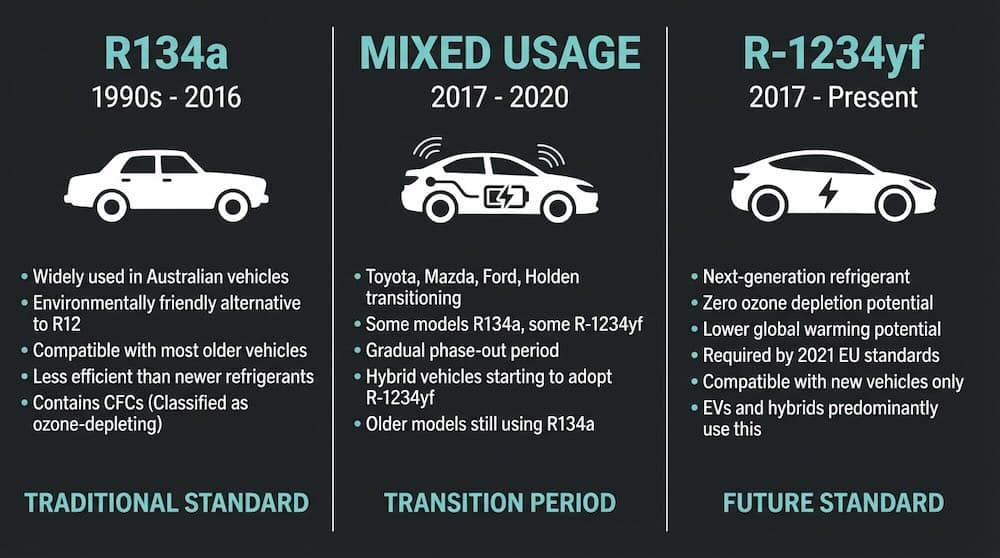
In Australia, the majority of vehicles on the road still run R134a, especially anything built between the mid-1990s and around 2016. Newer cars, particularly models made from 2017 onward, increasingly use R-1234yf, which is the low-emission refrigerant replacing R134a in modern systems. A small number of older classics once used R12, but that gas has been banned for decades.
The easiest way is to find this out is to check the sticker under the bonnet. Look for:
- A label saying R134a or R-1234yf
- System charge amount in grams
- A safety warning symbol
If the sticker is missing (common on older cars), we can identify the gas during inspection.
At Voltaic, we’ve serviced thousands of AC systems across Perth, from a 90s Commodore to brand-new European hybrids. So here’s the straight answer, the reasons behind it, and a massive list of common Australian cars with their refrigerant type.
Quick Summary
- Cars built before mid-1990s likely used R12. This gas is banned today.
- Cars built mid-1990s to roughly 2014–2017 almost always use R134a.
- Most 2017–present vehicles, especially Euro, hybrid and EV models, use R-1234yf.
- Some EVs use specialised refrigerant blends depending on the cooling system.
- Your car has a sticker under the bonnet that confirms its exact gas type.
- If your AC isn’t cold, you may not need a regas. The issue could be a leak, compressor fault, or sensor problem. We diagnose that for you.
The Three Main Refrigerants in Australia
R12 (No Longer Used)
- Found in vehicles before about 1994.
- Banned in Australia due to environmental impact.
- If you own a restored classic, it will have been converted to R134a or retrofitted to run a safe alternative.
- We regularly service classic upgrades in our workshop.
R134a (Most Cars 1995 to around 2017)
The workhorse gas of Aussie motoring.
- Affordable and widely available.
- Reliable cooling performance.
- Seen in Toyotas, Holdens, Mazdas, Nissans, Fords, Subarus, Mitsubishis, Hyundais and more.
- If your AC is weak, you may need a leak check or a car aircon service rather than just a regas.
R-1234yf (Most New Cars from 2017 Onwards)
The new low-emissions refrigerant.
- Mandatory in many European vehicles, luxury brands, and hybrids.
- Safer for the environment and uses less energy.
- More expensive because it requires specialist recovery equipment and training.
- Yes, we service and regas R-1234yf systems in Perth.
List of Common Vehicles & Their Refrigerants
Below is the most accurate quick-reference list for the average Aussie driver.
| Make | Model / Series | Years / Details | Refrigerant |
|---|---|---|---|
| Toyota | Corolla | 1994–2016 | R134a |
| Toyota | Corolla | 2017–present | R-1234yf |
| Toyota | Camry | 1994–2017 | R134a |
| Toyota | Camry Hybrid | 2018–present | R-1234yf |
| Toyota | LandCruiser 80/100/200 Series | All listed generations | R134a |
| Toyota | LandCruiser 300 Series | All years | R-1234yf |
| Toyota | HiLux | All models up to 2020 | R134a |
| Toyota | HiLux | 2021–present | R-1234yf |
| Toyota | RAV4 | Pre-2019 | R134a |
| Toyota | RAV4 Hybrid | 2019–present | R-1234yf |
| Mazda | Mazda 2/3/6 | 1998–2016 | R134a |
| Mazda | Mazda 3/6/CX-5/CX-30 | 2017–present | R-1234yf |
| Mazda | CX-5 | Pre-2017 | R134a |
| Hyundai & Kia | i20, i30, Elantra | 1998–2016 | R134a |
| Hyundai & Kia | i30 | 2017–present | R-1234yf |
| Hyundai & Kia | Tucson / Santa Fe | Pre-2016 | R134a |
| Hyundai & Kia | Most models | 2017+ (gradual change) | R-1234yf (increasingly common) |
| Holden | Commodore (VR to VF) | All listed series | R134a |
| Holden | Cruze | All years | R134a |
| Holden | Astra | Older models | R134a |
| Ford | Falcon EF–FGX | All listed series | R134a |
| Ford | Ranger | Pre-2022 | R134a |
| Ford | Next-Gen Ranger | 2022–present | R-1234yf |
| Ford | Everest | 2022–present | R-1234yf |
| Nissan | Pulsar / Tiida | 1995–2016 | R134a |
| Nissan | X-Trail | Pre-2017 | R134a |
| Nissan | X-Trail | 2018–present | R-1234yf |
| Nissan | Navara D22/D40 | All listed models | R134a |
| Nissan | Navara NP300 | Varies by year | Mix of R134a and R-1234yf |
| Mitsubishi | Lancer / Outlander / Triton | Pre-2017 | R134a |
| Mitsubishi | Outlander / Triton (later models) | 2017–present (approx.) | R-1234yf |
| Subaru | Liberty / Impreza / Forester | Pre-2017 | R134a |
| Subaru | Most models | 2017–present | R-1234yf |
| Volkswagen | Golf Mk7 and earlier | All years for these generations | R134a |
| Volkswagen | Golf Mk8 | All years | R-1234yf |
| Audi / BMW / Mercedes / Volvo / Porsche | Most models | 2016–present | R-1234yf |
| Various European | Older models | Pre widespread switch | R134a |
| EVs (Tesla, BYD, MG, Hyundai Ioniq etc.) | Most models | Cabin and battery thermal management | R-1234yf (most) |
You can learn more about EV air conditioning here: EV Air Conditioning Guide.
How to Identify Your Car’s Refrigerant
Even with the list above, the surest way is the sticker under the bonnet. Look for:
- A label saying R134a or R-1234yf
- System charge amount in grams
- A safety warning symbol
If the sticker is missing (common on older cars), we can identify the gas during inspection.
Why Knowing Your Refrigerant Type Matters
- Using the wrong gas can damage the system.
- Not all workshops are licensed to handle R-1234yf.
- Hybrid and EV AC systems require special handling.
- Pricing changes depending on the gas type.
- AC faults are often caused by leaks or a failing compressor, not just low refrigerant. See our troubleshooting guide here: How to Tell if Your Car Aircon Needs Regassing.
Signs Your Car May Need an AC Check
- It takes ages to cool down.
- Air feels cool but not cold.
- A weird smell comes through the vents. That one’s covered here: Why Does the Air Conditioning in Your Car Smell?
- The AC only works while driving.
- You hear clicking or rattling from the compressor.
If you’re noticing any of these, your refrigerant may not be the problem. A proper diagnostic check tells you exactly what’s going on.
Why Drivers Choose Voltaic for AC Regassing and Repair
- Over 20 years hands-on aircon experience
- Dual-trade auto electricians trained in modern AC systems
- Fully equipped workshops in Welshpool and Wangara
- We handle everything from R134a to R-1234yf to EV cooling
- Transparent communication and no surprises
- Emergency, urgent and planned AC repairs available
We don’t just top up the gas. We check the system properly so you don’t waste money on repeat regasses.
When to Book an AC Service
If your AC hasn’t been checked in the last couple of years, or your vehicle is running R-1234yf, it pays to stay ahead of faults. A failed compressor can cost thousands. A $199 service keeps you out of trouble.
Book your service here: Car Aircon Service.