

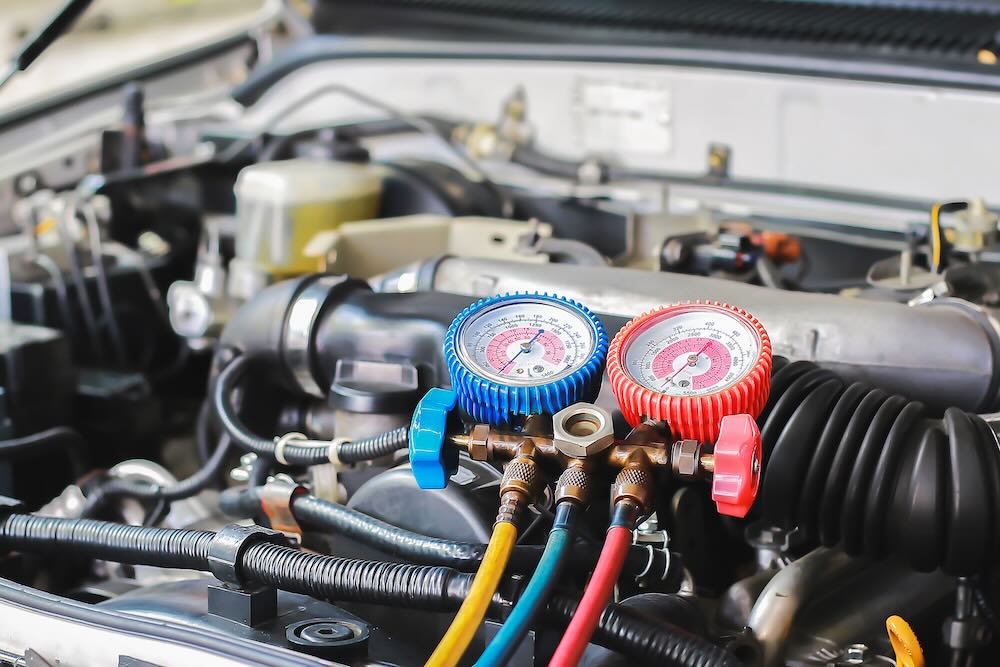
How does the AC system work in a car? In simple terms, a car’s air conditioning system removes heat and moisture from the air inside the cabin, then blows cooler, drier air back at you. It does this by circulating refrigerant through a sealed system, changing it from a gas to a liquid and back again to absorb heat and release it outside the vehicle.
Think of it like a fridge on wheels. The system does not “create cold”. Instead, it pulls heat out of the cabin and dumps it outside.
This guide explains how does the AC system work in a car, step by step, with plain language and real-world examples so you can understand what is happening when you press that AC button.
Key Takeaways
- A car AC system removes heat, it does not create cold
- Refrigerant cycles through compression, cooling, expansion, and evaporation
- Heat is absorbed inside the cabin and released outside the vehicle
- Moisture is removed to improve comfort and demisting
- Electrical controls are just as important as mechanical parts
- Regular servicing keeps the system efficient and protects major components
What A Car AC System Actually Does
Before looking at parts, it helps to understand the job the system is doing.
A car air conditioning system is designed to:
- Remove heat from inside the cabin
- Remove moisture from the air
- Maintain a comfortable and stable cabin temperature
- Prevent windows from fogging up
Even in winter, your AC plays a role. When you select demist, the AC runs in the background to dry the air before it hits the windscreen.
How Does a Car AC System Work?
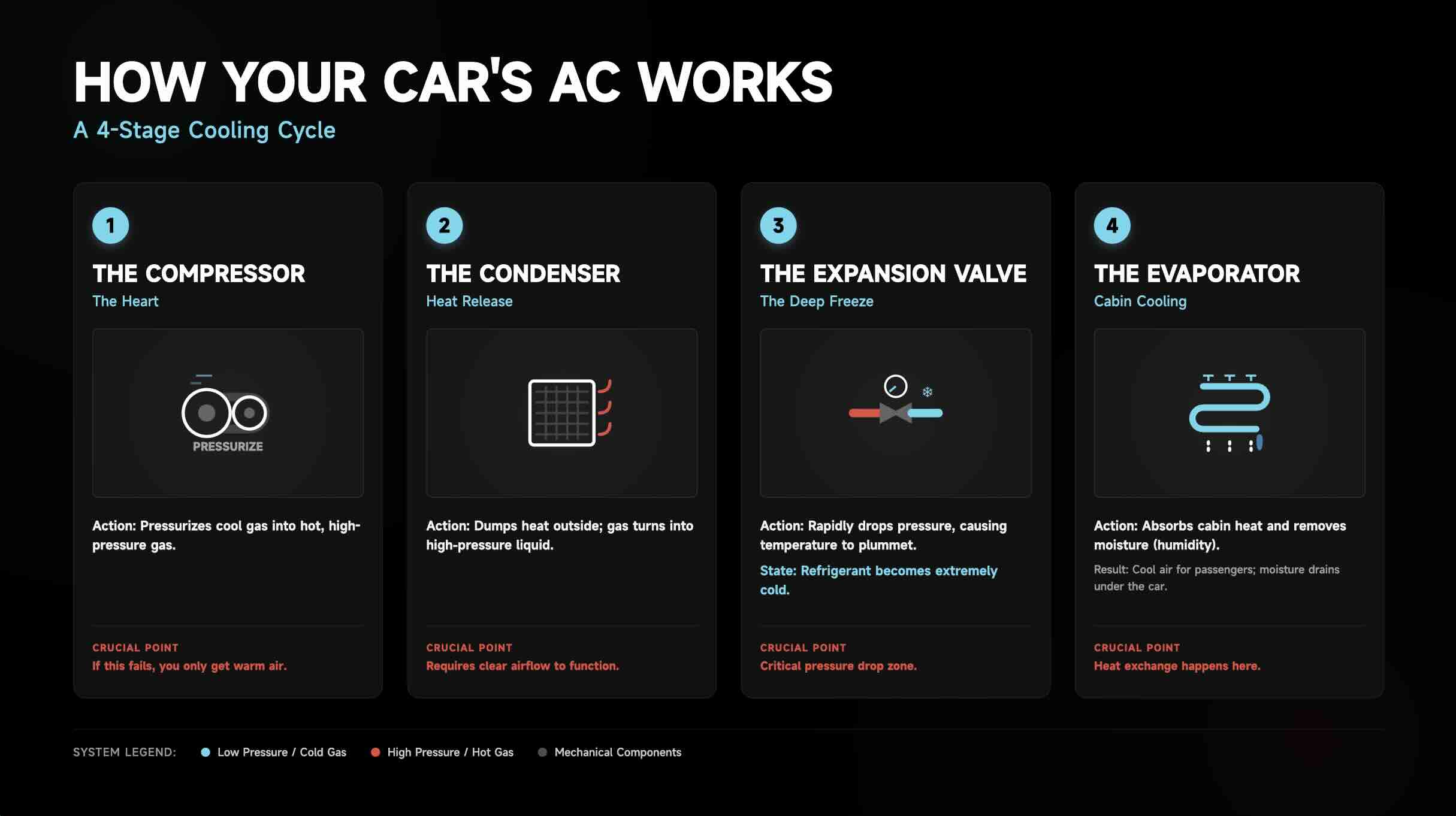
At its core, how the AC system works in a car can be broken into four repeating stages.
- Compression
- Heat release
- Expansion
- Heat absorption
This cycle repeats continuously while the AC is running.
Stage 1: The Compressor Pressurises The Refrigerant
The compressor is the heart of the system.
It is driven by the engine via a belt or, in electric vehicles, by a high-voltage electric motor. Its job is to compress low-pressure refrigerant gas into a high-pressure, high-temperature gas.
A simple way to picture this is pumping air into a bike tyre. As pressure increases, temperature rises too.
What this means in practice:
- Refrigerant enters the compressor as a cool, low-pressure gas
- It leaves as a hot, high-pressure gas
- This pressure change is what allows heat to be moved later in the system
If the compressor fails, the entire AC system stops working. This is why compressor issues often lead to warm air only.
Stage 2: The Condenser Releases Heat Outside The Car
From the compressor, the hot refrigerant flows to the condenser. The condenser is usually mounted at the front of the car, near the radiator.
Its role is to dump heat outside.
As air flows across the condenser while driving, or via the radiator fans when stationary, the refrigerant cools down and changes state.
What happens here:
- Hot, high-pressure gas enters the condenser
- Heat is released into the outside air
- Refrigerant condenses into a high-pressure liquid
This stage is crucial. If airflow is blocked by debris, or the condenser is damaged, the system cannot get rid of heat effectively.
Stage 3: The Expansion Valve Drops Pressure
Once the refrigerant has cooled and turned into a liquid, it flows through an expansion valve or orifice tube.
This component acts like a controlled bottleneck.
Its job is to:
- Reduce refrigerant pressure rapidly
- Control how much refrigerant enters the evaporator
- Prepare the refrigerant to absorb heat
As pressure drops, temperature drops with it. The refrigerant becomes extremely cold at this point.
Stage 4: The Evaporator Absorbs Heat From The Cabin
The evaporator sits inside the dashboard, behind the vents.
Warm cabin air is blown across the evaporator fins by the blower fan.
As this happens:
- Cold refrigerant absorbs heat from the air
- Refrigerant boils back into a low-pressure gas
- Moisture in the air condenses and drains out under the car
- Cool, dry air is blown back into the cabin
This is the moment you actually feel the cold air.
The refrigerant then returns to the compressor, and the cycle starts again.
Why Car AC Removes Moisture As Well As Heat
One of the most misunderstood parts of how does the AC system work in a car is moisture removal.
When warm air passes over the cold evaporator:
- Water vapour in the air condenses into liquid
- This water drains outside the vehicle
- Cabin air becomes drier
That is why AC is so effective for demisting windows. Dry air clears fog far faster than warm, damp air alone.
What are the Electrical Components of a Car AC System?
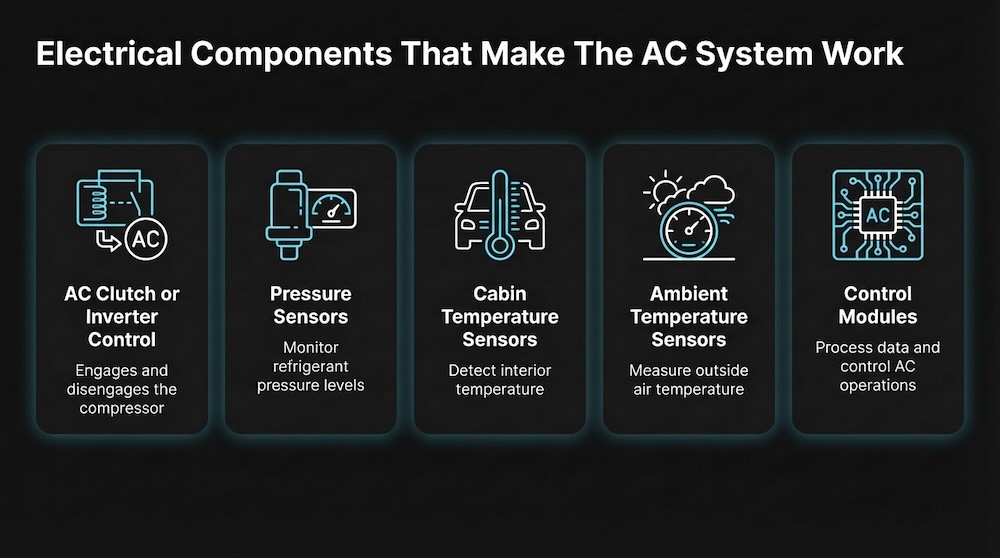
A car AC system is not just mechanical. It relies heavily on electrical control.
Key electrical parts include:
- AC clutch or inverter control
- Pressure sensors
- Cabin temperature sensors
- Ambient temperature sensors
- Control modules
These components work together to:
- Prevent damage from overpressure or underpressure
- Cycle the compressor on and off
- Adjust cooling output automatically
- Protect the system if a fault is detected
Modern vehicles can disable the AC entirely if a sensor reports unsafe conditions.
How Refrigerant Plays A Critical Role
Refrigerant is the fluid that carries heat around the system.
Common refrigerants include older R134a and newer R1234yf systems. Each has different properties, pressures, and service requirements.
Refrigerant must be:
- At the correct type for the vehicle
- At the correct quantity
- Free of moisture and contamination
Even a small loss of refrigerant can significantly reduce cooling performance. Low refrigerant also reduces lubrication inside the compressor, which can lead to expensive failures.
Why AC Performance Drops Over Time
Car AC systems are sealed, but not perfectly.
Over time:
- Microscopic leaks occur through seals and hoses
- Refrigerant slowly escapes
- Oil levels inside the system change
- Performance gradually declines
This is why periodic servicing and regassing is recommended, even if the system still feels like it is working.
Common Problems That Affect How Car AC Works
Understanding how the AC system works in a car also helps explain common faults.
Typical issues include:
- Weak cooling due to low refrigerant
- Warm air caused by compressor failure
- Bad smells from bacteria on the evaporator
- Intermittent cooling from electrical sensor faults
- No cooling at idle due to condenser airflow issues
Each of these faults interrupts one stage of the AC cycle.
How Modern Vehicles And EVs Change AC Operation
In newer vehicles, especially hybrids and electric cars, the basic principles stay the same, but the drive method changes.
Instead of a belt-driven compressor:
- Electric compressors are used
- High-voltage systems power the AC
- Cooling can operate even when the vehicle is stationary
This is why EV air conditioning servicing must be done by qualified technicians with the correct equipment.
Why Professional Servicing Matters
Because car AC systems combine:
- Refrigerant handling
- High pressures
- Electrical controls
- Engine or high-voltage integration
They are not a DIY system.
At Voltaic Auto Electrical, our car aircon servicing is handled by qualified auto electricians with dedicated AC certification, proper recovery equipment, and diagnostic tools. Our approach focuses on safety, transparency, and long-term reliability, backed by decades of hands-on experience in automotive electrical and air conditioning systems.
Conclusion
Once you understand how the AC system works in a car, it becomes clear why small issues can quickly turn into major problems if ignored. The system relies on precise pressures, clean refrigerant, and accurate electrical control to operate properly.
If your air conditioning is not cooling like it used to, smells bad, or behaves inconsistently, it is usually a sign that one part of the cycle is no longer working as it should. Addressing these issues early helps avoid costly repairs and keeps your vehicle comfortable year-round.