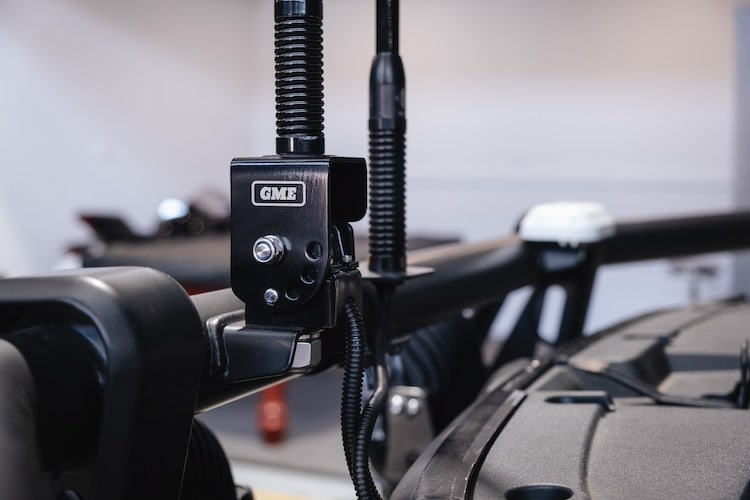
A UHF radio is a two-way radio that uses ultra high frequency signals to send and receive short-distance voice communication. In Australia, when people talk about a UHF radio for a 4WD, work ute, truck, convoy or mine spec vehicle, they usually mean an Australian UHF CB radio that operates on the 476.425 to 477.4125 MHz band.
Unlike a mobile phone, a UHF radio does not need mobile reception, a SIM card or a phone tower to talk directly to nearby radios. That is why UHF radios are so popular with 4WD owners, tradies, truck drivers, fleet operators, remote travellers and anyone who needs quick vehicle-to-vehicle communication when phone service is patchier than a dodgy backyard wiring job.
Quick Summary
- A UHF radio is a two-way radio that sends and receives short-distance voice messages using ultra high frequency radio waves.
- In Australia, UHF CB radios operate across 80 channels in the 476.425 to 477.4125 MHz range.
- UHF radios are commonly used for 4WD convoys, towing, worksites, farms, road trips, traffic management, mining, logistics and remote travel.
- A compliant Australian UHF CB radio can be used under the CB class licence without applying for an individual licence or paying licence fees, but users still need to follow the rules.
- UHF radio range depends on terrain, antenna height, obstructions, radio power, installation quality and whether a repeater is used.
- Channels 5 and 35 are reserved for emergency use in Australia, but UHF radio is not a replacement for calling Triple Zero where phone service is available.
- A properly installed in-vehicle UHF radio is usually better than a handheld for regular 4WD, work vehicle and fleet use.
- The best UHF setup depends on your vehicle, how you use it, where you travel and whether you need convoy communication, repeater access or worksite reliability.
What Is A UHF Radio?
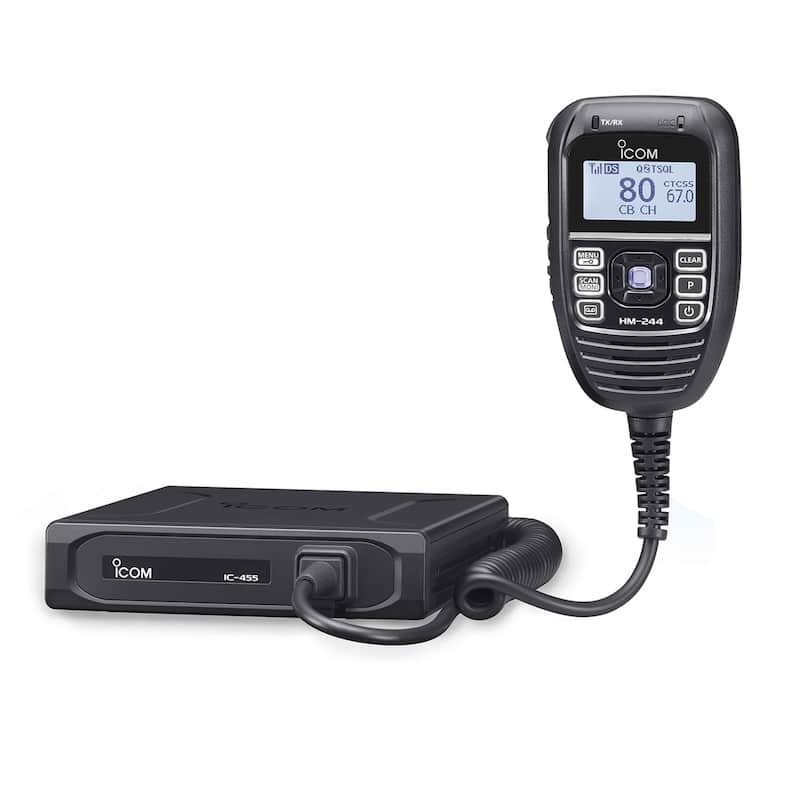
A UHF radio is a radio communication device that uses the ultra high frequency band to transmit and receive messages. UHF stands for ultra high frequency, which covers 300 to 3000 MHz in the radiofrequency spectrum.
In simple terms, a UHF radio lets one person press a button, talk into a microphone, and have nearby radios hear that message almost instantly.
That makes it different from a mobile phone. A phone usually needs network coverage. A UHF radio can communicate directly from radio to radio, as long as the other radio is within practical range and tuned to the same channel.
For Australian drivers, the most common type is a UHF CB radio. CB means citizen band. It is a public radio service used for short-distance communication. ACMA says CB radio can be used for short-distance communication, voice communications, telemetry and telecommand, with all users operating on shared frequencies.
A UHF CB radio is not private. Anyone nearby on the same channel can usually hear what you say. It is more like a shared radio lane than a private phone call.
Think of it like this:
You are in a 4WD convoy heading out past phone coverage. The lead vehicle spots a washout, presses the push-to-talk button and says, “Slow down, rough section ahead.” Every vehicle on the same UHF channel hears it straight away. No ringing around. No missed calls. No one finding out the hard way.
That is the basic value of UHF. Fast, simple, shared communication.
How Do UHF Radios Work?
UHF radios work by turning your voice into a radio signal, sending it through an antenna, and allowing another radio on the same channel to receive and turn that signal back into sound.
Here is the simple version:
- You press the push-to-talk button.
- The radio turns your voice into an electrical signal.
- The transmitter sends that signal through the antenna.
- The antenna radiates the signal as a radio wave.
- Another radio tuned to the same channel receives the signal.
- The receiving radio turns it back into audio.
The key point is that UHF radios are usually one-at-a-time communication. When one person is talking on a channel, others should wait. That is why basic radio manners matter. Press, pause, speak clearly, then release the button.
If you press and start speaking straight away, the first word can get clipped. That is how “watch the roo” becomes “the roo”, which is not ideal when the roo is already having a poor morning.
How A UHF Radio Message Travels
Simple, quick and direct. No mobile tower needed when radios are within practical range.

1
Press
The driver presses the push-to-talk button on the microphone or handheld unit.
2
Speak
The radio converts the voice message into a radio signal.
3
Transmit
The antenna sends the signal out across the selected UHF channel.
4
Receive
Nearby radios on the same channel pick up the signal.
5
Hear
The receiving radio turns the signal back into clear audio.
Voltaic tip: A clean install, correct antenna position and tidy wiring can make a big difference. Radios are simple to use, but setup still matters.
Why Do UHF Radios Use Channels?
UHF radios use channels so users can tune into the same frequency without manually entering technical frequency numbers.
Instead of saying, “Switch to 476.675 MHz,” drivers can simply say, “Go to channel 11.”
Australian UHF CB radios are usually sold with pre-programmed channels. Most modern CB stations have 80 pre-programmed UHF channels, while older 40-channel sets only operate on the older 25 kHz channel layout.
Channels make UHF radios easy to use. You do not need to be a radio technician to join a convoy. You just need to agree on a channel and follow the basic rules.
For example:
- A 4WD group may use a general chat channel while travelling.
- A truck driver may listen to road channels to understand traffic conditions.
- A work crew may use a shared channel on a property, site or event.
- Emergency channels must be kept clear unless there is an actual emergency.
The channel system keeps things practical. It does not make conversations private, but it does make communication quick and organised.
What Is UHF Radio Used For?
UHF radio is used for short-distance, practical communication where fast group contact matters. In vehicles, it is especially useful when mobile phone reception is unreliable, unsafe to rely on, or too slow for the situation.
Common UHF radio uses include:
- 4WD convoy communication
- Caravan and towing communication
- Truck and heavy vehicle communication
- Mining and construction vehicle fit-outs
- Farm and station work
- Traffic management and road safety vehicles
- Event and site coordination
- Remote travel
- Emergency assistance when other options are limited
- Work ute and fleet communication
- Pilot and escort vehicles
- Camping and off-road trips
UHF radios are popular because they are simple. Everyone can hear the same message at the same time. That makes them useful for group movement, hazard warnings and quick instructions.
4WD Convoys
UHF radios are one of the most useful accessories for 4WD touring. They let drivers warn each other about hazards, turns, corrugations, soft sand, oncoming traffic and changes in plan.
For example, the lead vehicle can call out:
“Soft patch on the left. Stay right and keep momentum.”
That one message can save the next driver from getting bogged. Nobody wants to spend the afternoon digging because Steve in the first ute forgot to mention the sand had the consistency of cake mix.
For vehicles set up for touring, a UHF often works best alongside other electrical upgrades such as dual battery installation, lighting, dash cams and other 4WD auto electrical upgrades.
Towing And Caravanning
UHF radios are useful when towing caravans, trailers, boats or camper trailers. Drivers can communicate with others in the convoy, talk to spotters when reversing, and hear road updates from nearby heavy vehicle operators.
When towing, speed and spacing matter. A quick UHF call can help warn others about:
- Tight overtaking spots
- Road trains
- Low branches
- Rest stop changes
- Roadworks
- Mechanical trouble
- Loose straps or swaying loads
A UHF is not a replacement for safe driving, but it can help everyone stay on the same page.
Mining, Construction And Fleet Vehicles
UHF radios are commonly used in mining, construction, civil works and traffic management vehicles. They help drivers communicate on worksites, access roads, laydown areas and remote job locations.
For mine spec and fleet vehicles, UHF installation is often part of a broader fit-out. That may include warning lights, reverse alarms, battery systems, work lights, communications, GPS equipment and safety gear.
Voltaic offers fleet services, heavy duty fit-outs and mine spec vehicle fit-outs, with UHF radios listed as part of its auto electrical service range.
Farms And Rural Properties
On rural properties, UHF radios are useful for communication between vehicles, sheds, gates, machinery and workers. They can be quicker than calling someone, especially when people are moving between paddocks.
A farmer can warn another vehicle about livestock on a track, machinery movement or a gate that needs closing. Simple, useful, no drama.
Remote Travel
UHF radios are useful in remote areas because they do not depend on mobile phone towers for short-distance communication. Travellers often use them to talk to convoy vehicles, nearby drivers and other road users.
However, UHF should not be treated as your only emergency communication tool for remote travel. UHF range can be limited, and emergency channels are not guaranteed to be monitored. The Australian class licence notes that emergency services organisations do not monitor the emergency CB frequencies and channels.
For remote touring, a UHF radio is often best used alongside a satellite communication device, PLB, sound vehicle preparation and sensible trip planning.
What Is The Difference Between UHF And VHF Radios?
The main difference between UHF and VHF radios is the frequency band they use. VHF stands for very high frequency and covers 30 to 300 MHz. UHF stands for ultra high frequency and covers 300 to 3000 MHz.
In plain English:
- VHF uses lower frequencies and longer wavelengths.
- UHF uses higher frequencies and shorter wavelengths.
- UHF is widely used for Australian CB vehicle communication.
- VHF is common in other radio services, including marine radio and some commercial systems.
For most Australian 4WD, caravan, work ute and convoy users, UHF CB is the standard choice. It is widely available, widely understood and set up around Australian UHF CB channels.
UHF Vs VHF Comparison
| Feature | UHF Radio | VHF Radio |
|---|---|---|
| Frequency band | 300 to 3000 MHz | 30 to 300 MHz |
| Common vehicle use in Australia | UHF CB for 4WDs, trucks, convoys and worksites | Less common for general road and 4WD CB use |
| Wavelength | Shorter | Longer |
| Antenna size | Usually shorter and easier to fit to vehicles | Usually longer for comparable setups |
| Built-up areas | Often practical around vehicles, sites and urban obstructions | Can work well in open areas depending on the service and setup |
| Australian CB use | UHF CB operates on designated UHF CB channels | Australian CB also includes HF 27 MHz, not VHF |
| Best for most 4WD users | Yes | Usually no, unless using a specific licensed system |
Which Is Better for Vehicle Communication?
UHF Vs VHF For Vehicle Communication
Both are radio bands, but UHF CB is the practical go-to for most Australian 4WD, convoy and work vehicle setups.
UHF
Best Fit For Most 4WDs
- Common for Australian UHF CB radios
- Used by 4WD convoys, trucks and work vehicles
- Shorter antennas are easier to mount neatly
- Great for shared short-distance vehicle communication
VHF
Used In Other Radio Services
- Lower frequency band than UHF
- Common in marine and some commercial radio systems
- Not the usual choice for general Australian 4WD CB use
- May require different licensing depending on the service
Simple answer: For most Australian touring, towing, work ute and convoy setups, choose a compliant Australian UHF CB radio.
Is A UHF Radio The Same As A CB Radio?
A UHF radio is not always the same as a CB radio, but in Australia, many people use the terms together when talking about UHF CB radios.
Here is the difference:
- UHF describes the frequency band.
- CB describes the citizen band radio service.
- UHF CB describes the Australian citizen band service operating in the UHF band.
So when someone says, “I’m getting a UHF for the LandCruiser,” they usually mean they are getting a UHF CB radio installed.
Australia also has HF CB radio channels around 27 MHz. ACMA lists CB radio frequencies across HF and UHF, with UHF CB using 476.425 to 477.4125 MHz.
So, are CB radios UHF or VHF?
In Australia, CB radio includes HF CB and UHF CB. It is not VHF CB. For modern vehicle use, UHF CB is the common setup.
Do You Need A Licence For A UHF Radio In Australia?
For normal use of a compliant Australian UHF CB radio, you do not need to apply for an individual licence or pay licence fees. ACMA states that users do not need to apply for a class licence or pay fees, but they must follow the rules in the Radiocommunications (Citizen Band Radio Stations) Class Licence 2025 and the Radiocommunications Act 1992.
That means the licence is already in place as a class licence, provided you use compliant equipment and follow the rules.
This is where some people get caught out. “No application” does not mean “no rules.”
You still need to use the correct channels, avoid restricted uses, use compliant equipment and avoid causing harmful interference.
ACMA also warns that some two-way radios sold online do not meet Australian standards and rules, and overseas radios may use the wrong frequencies for Australia.
That is why buying a cheap radio online can be risky. It might look like a bargain, but if it is not compliant, it can cause interference and land you in hot water. Great if you enjoy paperwork. Less great if you enjoy keeping your money.
How Far Can A UHF Radio Transmit?
A UHF radio can transmit from a few hundred metres to many kilometres, depending on the radio, antenna, terrain and installation. There is no single fixed range that applies to every UHF radio.
The biggest factors are:
- Radio power
- Antenna type
- Antenna mounting height
- Hills, trees, buildings and terrain
- Vehicle position
- Weather and electrical interference
- Whether a repeater is used
- Quality of installation
- Battery voltage and wiring condition
Australian UHF CB radios are limited by the class licence conditions. The 2025 class licence schedule states UHF CB transmitters must be operated with a maximum transmitter power of 5 W for UHF CB use.
That does not mean every 5 W radio will perform the same. A properly installed in-vehicle 5 W UHF with a good antenna position will usually outperform a handheld 5 W radio used from inside a vehicle.
Why? Because the antenna matters.
A handheld radio sitting inside a metal vehicle cabin has a harder job. The vehicle body can block and weaken the signal. A fixed in-car UHF with an external antenna mounted properly has a clearer path to transmit and receive.
Typical Range Expectations
These ranges are general, real-world expectations only:
| Setup | Practical Range Expectation |
|---|---|
| Low-power handheld in rough terrain | Short range, sometimes under 1 km |
| 5 W handheld in open ground | Several kilometres in good conditions |
| 5 W in-vehicle UHF with external antenna | Often better convoy and road communication |
| UHF through a repeater | Can extend range significantly where repeaters are available |
| Hilly or built-up areas | Range can drop quickly |
| Flat open country | Range can improve noticeably |
UHF is often described as line-of-sight communication. That means hills, ranges, buildings and dense terrain can block or weaken the signal. ACMA notes that radio frequency characteristics affect how far a radio wave can travel and whether it can penetrate trees or buildings.
In flat country, two vehicles may get much better range than they would in steep bush tracks. In the hills, you might lose contact with someone who is only a short distance away but tucked behind a ridge.
Very annoying. Very normal.
What Are UHF Repeaters?
A UHF repeater receives a radio signal and retransmits it from a higher or better-positioned location, helping extend communication range.
Repeaters are often installed on hills, towers or high points. Instead of your radio only talking directly to another radio, it talks to the repeater, and the repeater rebroadcasts your message across a wider area.
ACMA states that to operate a CB repeater station, an apparatus licence is required. Users near a repeater can operate through it in the UHF band on assigned repeater channels.
For normal users, the practical thing to know is this:
- Your radio needs duplex or repeater mode turned on.
- You need to use the correct repeater channel.
- There must be a suitable repeater in range.
- Not every area has repeater coverage.
- Repeaters should not be treated as guaranteed emergency infrastructure.
ACMA lists UHF repeater output channels 1 to 8 and 41 to 48, with matching input channels 31 to 38 and 71 to 78.
If you travel remotely, it is worth checking local repeater availability before you leave.
What Are The Emergency Channels On UHF Radio?
The emergency channels on Australian UHF CB radio are channels 5 and 35. ACMA identifies UHF channels 5 and 35 as emergency channels, with channel 9 used in the HF CB band.
The 2025 class licence says a person must not operate on 476.525 MHz, UHF channel 5, or 477.275 MHz, UHF channel 35, unless it is during an emergency, natural disaster, or for emergency services response purposes.
A few key points:
- Channel 5 is the main UHF emergency channel.
- Channel 35 is paired with channel 5 for repeater use.
- Do not use channels 5 or 35 for general chat.
- Do not test, joke or play around on emergency channels.
- Emergency services do not monitor these channels.
- UHF is not a substitute for calling Triple Zero where a public telecommunications network is available.
For emergency use, keep the message clear:
- Say “emergency, emergency, emergency.”
- State your location.
- State the problem.
- State how many people are involved.
- Say what help is needed.
- Keep the channel clear and listen.
If you are in mobile range, call Triple Zero. If you are not, UHF may help you reach nearby radio users, but it should not be your only safety plan for remote travel.
What Is Squelch On A UHF Radio?
Squelch is a setting that controls when your UHF radio speaker opens and plays sound. It helps stop constant static, hiss and background noise when no clear signal is being received.
In plain English, squelch is the radio’s noise gate.
If squelch is set too low, you may hear constant crackling, static and random noise.
If squelch is set too high, weak but useful signals may be blocked.
The aim is to set squelch high enough to stop background noise, but low enough to hear real transmissions.
Many modern UHF radios have automatic squelch or simple preset squelch levels. Older or more advanced units may let you adjust it manually.
A basic way to set squelch:
- Turn the volume to a normal level.
- Lower squelch until you hear static.
- Raise squelch until the static just disappears.
- Test with another radio if possible.
Do not confuse squelch with privacy. Squelch only controls what you hear. It does not make your channel private.
What Is CTCSS On A UHF Radio?
CTCSS stands for Continuous Tone-Coded Squelch System. It uses a sub-audible tone to help your radio ignore transmissions that do not use the same tone.
Some people call these “privacy codes,” but that name is misleading. They do not make your conversation private. They only reduce what you hear from other users on the same channel.
For example, two groups may be using channel 18. One group uses CTCSS tone 12. Their radios may only open squelch when that tone is present. They will hear less chatter, but other users on channel 18 can still potentially hear their transmission if their radios are not filtering it.
CTCSS is useful for work crews, convoys and repeat users who want less noise on a busy channel.
But it should be used carefully. If you set tones and forget they are on, you may miss other radio users on the same channel. That can be a problem on shared tracks, worksites and emergency situations.
Can UHF Radios Be Private?
Standard UHF CB radio conversations are not private. Anyone nearby on the same channel can usually listen.
That means you should not share sensitive information over UHF, such as:
- Personal details
- Payment information
- Private addresses
- Site access codes
- Medical details unless needed in an emergency
- Anything you would not want another road user to hear
The class licence also includes restrictions around encrypted speech in certain uses, including emergency frequencies and communication through a CB repeater station.
For business users who need secure communication, a different licensed commercial radio system may be more suitable. For everyday UHF CB use, treat it as public.
What Channels Should You Use On A UHF Radio?
The best UHF channel depends on what you are doing, where you are and who you need to talk to. Australian UHF CB has shared channels, restricted channels and repeater channels.
You should always follow the channel rules, but the basic idea is:
- Use agreed general channels for convoy chat.
- Keep emergency channels clear.
- Do not use data-only channels for voice.
- Use repeater channels correctly.
- Avoid interfering with other users.
- Move channels if a channel is busy.
ACMA states that telemetry and telecommand can only be used on UHF channels 22 and 23, and voice cannot be used on those channels.
So, no voice chat on channels 22 and 23. Simple.
For convoys, choose a clear general-use channel and keep the conversation short and useful. You do not need to narrate every bump in the track. The rest of the convoy can feel them too.
UHF Radio Manners: How To Use One Properly
Good UHF manners make communication clearer and safer.
Follow these simple habits:
Listen Before You Talk
Before transmitting, listen to make sure the channel is clear. If someone else is already talking, wait.
Press, Pause, Speak
Press the button, pause for half a second, then speak. This prevents your first word from being cut off.
Keep It Short
Say what matters. Long rambling transmissions block the channel for everyone else.
Use Clear Language
Speak calmly and clearly. Avoid slang that others in the group may not understand.
Identify Who You Are Calling
Say the name or vehicle you are calling first, then your name.
Example:
“Lead vehicle, this is blue Hilux. Can we pull over at the next safe spot?”
Keep Emergency Channels Clear
Never use channels 5 and 35 for general chat.
Do Not Use Offensive Language
UHF is public. Other drivers, families, worksites and emergency volunteers may be listening.
Do Not Talk Over Others
Only one radio can be clearly heard at a time on a channel. If two people transmit at once, both messages may be unreadable.
Confirm Important Messages
For safety messages, ask for confirmation.
Example:
“Track blocked after the bend. Confirm you copied?”
This matters when the message affects driving, safety or recovery.
Handheld Vs In-Vehicle UHF Radios
The main difference between handheld and in-vehicle UHF radios is power supply, antenna performance, convenience and reliability.
A handheld UHF radio is portable. You can carry it outside the vehicle, use it around camp, lend it to a spotter, or take it on short trips.
An in-vehicle UHF radio is mounted in the vehicle and connected to a power supply and external antenna. This is usually the better option for regular touring, towing, fleet and work vehicle use.
Handheld UHF Radios
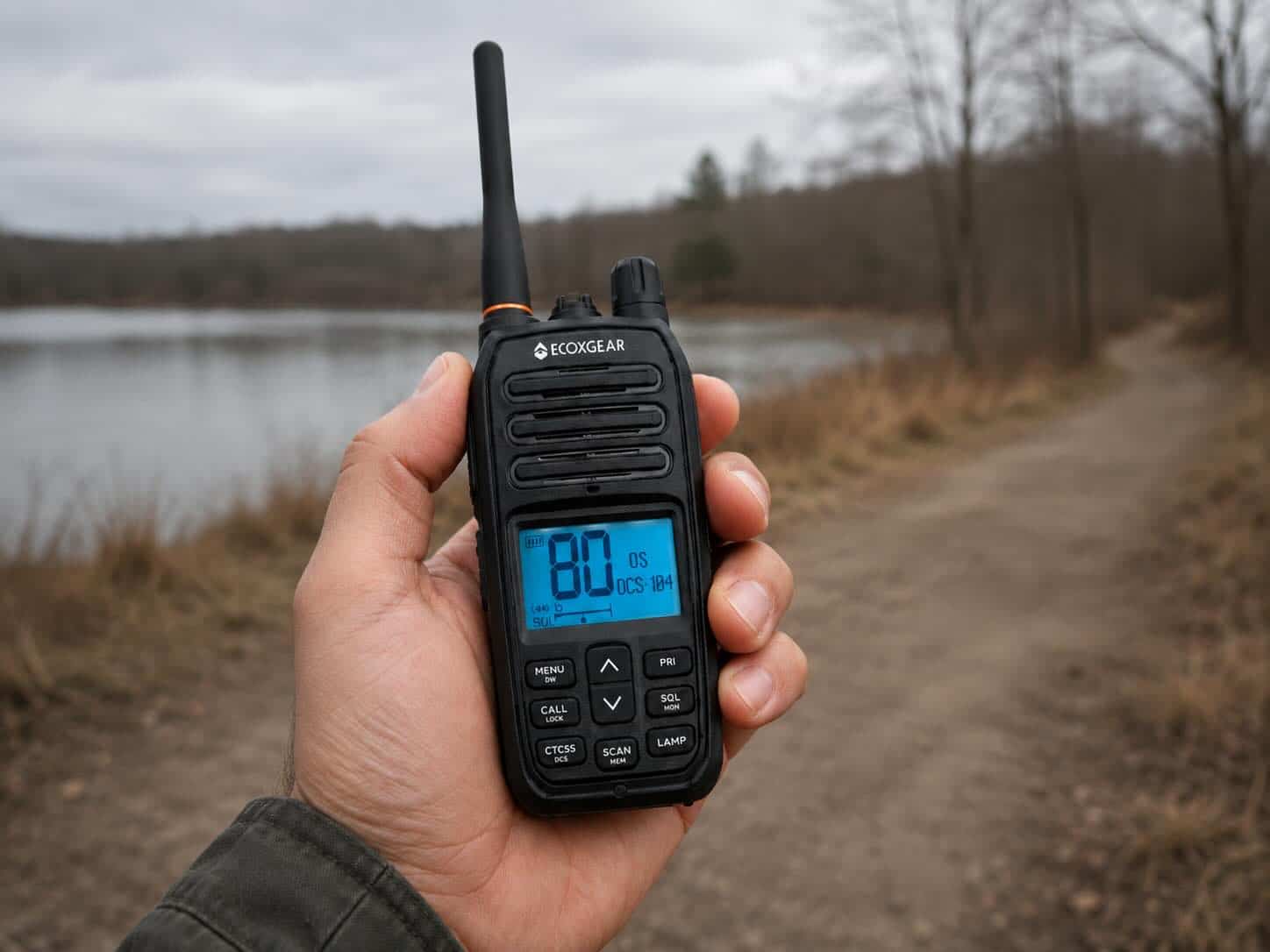
Handheld units are useful for:
- Spotting during recoveries
- Campsite communication
- Short-range convoy backup
- Occasional use
- Passengers outside the vehicle
- Events and foot-based communication
The downsides are:
- Battery life is limited.
- Range can be reduced inside a vehicle.
- Antenna performance is usually lower.
- They can be misplaced, dropped or left flat.
- Audio may not be as clear in noisy vehicles.
In-Vehicle UHF Radios
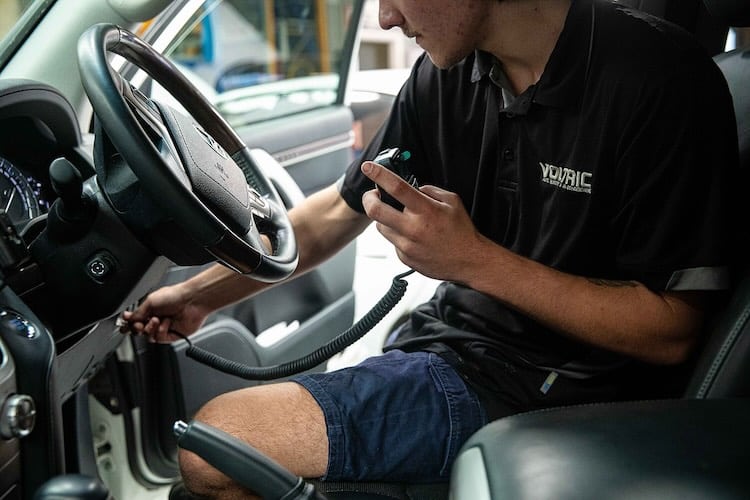
Fixed in-vehicle units are useful for:
- 4WD touring
- Caravanning
- Work utes
- Trucks
- Fleet vehicles
- Mine spec vehicles
- Regular convoy use
- Drivers who want a cleaner and more reliable setup
The benefits include:
- External antenna mounting
- Vehicle power supply
- Better convenience
- Cleaner microphone placement
- More reliable everyday use
- Neater integration with the vehicle
For anyone regularly travelling off-road, towing long distances or setting up a work vehicle, a fixed UHF is usually the better long-term option.
Voltaic provides UHF radio installation in Perth, with UHF radio installation listed from $250 as a limited-time offer in its service information.
Where Should A UHF Antenna Be Mounted?
A UHF antenna should be mounted where it has a clear path to transmit and receive, while also being practical and safe for the vehicle.
Common mounting locations include:
- Bull bar
- Roof rack
- Gutter mount
- Bonnet bracket
- Rear bar
- Tray or canopy mount
The best location depends on the vehicle, antenna type and how the vehicle is used.
A roof-mounted antenna often has a good signal pattern because it sits high and clear. But it may be vulnerable to low branches, carparks and height restrictions.
A bull bar mount is popular because it is practical and accessible. It is not always perfect for signal pattern, but it works well for many 4WDs and touring vehicles.
A rear mount may be neat, but the vehicle body can block signal in some directions.
For many Perth drivers, the “best” mount is the one that balances performance, clearance, durability and real-world use. No point having a perfect antenna position if the first low branch in Dwellingup turns it into modern art.
What Antenna Should You Use With A UHF Radio?
The right antenna depends on where you drive.
UHF antennas are often discussed in terms of gain, measured in dBi. The gain affects the shape of the signal pattern.
A low-gain antenna sends the signal in a taller, more rounded pattern. This can be better in hilly or uneven terrain because the signal has more vertical spread.
A high-gain antenna sends the signal in a flatter, wider pattern. This can work well on flat open roads because the signal is pushed more outward.
Simple Antenna Guide
| Driving Situation | Antenna Type To Consider | Why |
|---|---|---|
| Hilly bush tracks | Lower gain antenna | Better signal spread over uneven terrain |
| General 4WD touring | Medium gain antenna | Good all-round choice |
| Flat open highways | Higher gain antenna | Better suited to long, flat stretches |
| Mixed Perth and touring use | Medium gain antenna | Practical compromise |
| Worksites and fleets | Depends on site layout | Install should match the vehicle and operating area |
Many drivers choose a medium-gain antenna because it is a good all-rounder. It may not be perfect everywhere, but it handles mixed use well.
What To Look For When Buying A UHF Radio
When buying a UHF radio, look for Australian compliance, 80-channel UHF CB operation, 5 W output, clear audio, good controls, suitable antenna options and a professional installation path.
Here is what matters.
1. Australian Compliance
Buy a radio designed and approved for Australian use. ACMA warns that some overseas two-way radios may not meet Australian rules, may use unsafe frequencies and may cause dangerous interference.
Look for known brands, proper Australian supply and the Regulatory Compliance Mark where required.
2. 80-Channel UHF CB
Most modern Australian UHF CB radios use 80 channels. This is the standard expectation for new vehicle setups. The 2025 class licence notes that most modern CB stations have 80 pre-programmed channels.
3. 5 W Transmit Power
For vehicle use, a 5 W UHF CB is generally the standard choice. Australian UHF CB conditions include a maximum transmitter power of 5 W for UHF CB.
A lower-power handheld may be fine for short-range use, but for vehicles, a fixed 5 W unit is often the practical pick.
4. Suitable Antenna
The antenna has a big impact on performance. Choose one based on terrain, vehicle use and mounting position.
A good installer can help you avoid the common mistake of choosing an antenna purely because it looks tough. Looking tough is nice. Working properly is better.
5. Clear Speaker And Microphone
Cabin noise matters. Diesel engines, tyres, wind, work gear and open windows can make radio audio harder to hear.
Look for:
- Clear speaker output
- Good microphone quality
- Easy-to-use controls
- A microphone location that does not get in the way
- Optional external speaker support if needed
6. Display And Controls
Some UHF radios have the main controls on the microphone. Others have a separate head unit. Compact units are great for modern vehicles where dash space is limited.
Consider:
- Can the driver reach it safely?
- Is the display easy to read?
- Can channels be changed quickly?
- Is the microphone mount secure?
- Will it suit the vehicle interior?
7. Duplex And Repeater Access
If you travel through areas with UHF repeaters, make sure the radio supports duplex mode. Most quality modern UHF CB radios do.
8. Scan Function
Scanning lets the radio monitor multiple channels. This can be useful for road travel, convoys and work use.
9. Build Quality
For 4WDs, work vehicles and fleet vehicles, choose a radio that can handle heat, vibration, dust and regular use.
10. Professional Installation
A UHF radio is only as good as the setup around it. Poor antenna placement, messy wiring, weak power connections or bad cable routing can all hurt performance and reliability.
A good installation should include:
- Secure radio mounting
- Clean microphone placement
- Correct power connection
- Proper fuse protection
- Safe cable routing
- Suitable antenna positioning
- Neat wiring
- Testing before handover
Voltaic’s team installs UHF radios as part of its auto electrical services and offers broader vehicle fit-out support for fleet, heavy duty, mine spec, 4WD and touring setups.
Infographic 3: UHF Buyer Checklist
UHF Radio Buyer Checklist
Before you buy, make sure the radio suits Australian rules, your vehicle and the places you actually drive.
✓
Australian Compliant
Choose equipment made for Australian UHF CB channels and rules.
✓
80 Channel Ready
Most modern UHF CB radios use the current 80-channel layout.
✓
Right Antenna
Match the antenna to your terrain, vehicle height and use case.
✓
Clean Install
Good wiring, fusing and antenna placement help the setup perform properly.
✓
Easy Controls
The driver should be able to use the radio safely and quickly.
✓
Vehicle Fit
The unit, microphone and antenna should suit your cabin, bar work and accessories.
Need a UHF installed properly? Voltaic can help match the unit, antenna and install to your vehicle.
Common UHF Radio Mistakes
UHF radios are simple to use, but a few mistakes can make them less effective.
Buying The Wrong Radio
Do not buy a random overseas radio just because it is cheap. It may not be compliant for Australian use and may be programmed for the wrong frequencies. ACMA warns that non-compliant radios can cause dangerous interference, including interference to emergency services communication.
Using Emergency Channels For General Chat
Channels 5 and 35 are reserved for emergency use. Keep them clear.
Mounting The Antenna Poorly
An expensive radio with a badly placed antenna can perform worse than a sensible radio with a good antenna setup.
Hiding The Microphone In An Awkward Spot
If the microphone is hard to reach, tangled in the console or mounted where it hits your knee, it will annoy you every time you use it.
Running Messy Wiring
Loose wiring can rub, rattle, short or fail. Auto electrical gear should be installed cleanly and safely.
Expecting UHF To Work Like A Satellite Phone
UHF is great for nearby communication. It is not a guaranteed long-distance emergency device.
Leaving CTCSS On By Accident
Tone settings can stop you hearing other users on the same channel. Handy when used correctly. A pain when forgotten.
Talking Too Much
A UHF channel is shared. Keep messages short and useful. Nobody needs a podcast episode over channel 18.
Should You Install A UHF Radio Yourself?
You can install some UHF radios yourself if you understand vehicle wiring, antenna placement, fuse protection and safe cable routing. But for many modern vehicles, professional installation is the better option.
A professional install is especially worthwhile if:
- The vehicle is new or near-new.
- The vehicle has airbags, complex trim or advanced electronics.
- You want hidden wiring.
- The antenna needs proper mounting.
- You are integrating the UHF with other accessories.
- The vehicle is used for work, fleet, mining or commercial purposes.
- You want the setup tested properly.
Modern vehicles are not as forgiving as older ones. A rough install can damage trim, interfere with electronics, create electrical faults or leave the setup unreliable.
Voltaic’s service information highlights auto electrical work including UHF radios, dual batteries, dash cams, reverse cameras, electric brakes, car lighting, fleet services, mine spec fit-outs and heavy duty fit-outs.
If you are already setting up a 4WD or work vehicle, it makes sense to plan the UHF installation with the rest of the electrical layout. That can help avoid messy wiring, duplicated labour and accessories fighting for the same mounting space.
Where Does A UHF Radio Fit In A 4WD Setup?
A UHF radio is usually one part of a practical 4WD electrical setup. It handles communication, but it often works alongside other gear that supports safety, touring and daily usability.
A typical 4WD setup may include:
- UHF radio
- Dual battery system
- Driving lights or spotlights
- Work lights
- Dash cam
- Reverse camera
- Electric brake controller
- Anderson plugs
- Fridge wiring
- Solar input
- Compressor wiring
- Switch panels
- USB and accessory outlets
If you are building a touring vehicle, plan the electrical system as a whole. A well-planned setup is easier to use, easier to diagnose and less likely to become a spaghetti bowl behind the dash.
Voltaic offers related services such as dual battery installation, dash cam installation, electric brake controller installation and car LED lighting installation.
Is A UHF Radio Worth It?
A UHF radio is worth it if you travel in convoy, tow, drive off-road, work on sites, run fleet vehicles or spend time outside reliable mobile coverage.
It gives you fast, shared communication without needing to unlock a phone, search for reception or ring each person separately.
A UHF radio is especially worth it for:
- 4WD owners
- Caravan owners
- Touring drivers
- Tradies with work utes
- Mining and civil vehicles
- Traffic management vehicles
- Farm vehicles
- Fleet operators
- Remote travellers
- Clubs and convoy groups
For a city-only daily driver, you may not use one often. For a touring, towing or work vehicle, it can quickly become one of those accessories you wonder how you managed without.
UHF Radio Installation In Perth
Voltaic installs UHF radios for Perth drivers who want a clean, practical and reliable setup. The team can help with unit selection, antenna placement, wiring, mounting and testing, so your radio is ready for real use.
Voltaic is a Western Australian owned and operated auto electrical business established in 2017, with services including UHF radio installation, dual battery installation, dash camera installation, car lighting, heavy duty fit-outs and auto diagnostics.
The business is backed by strong hands-on experience, with owner Josh Doutch having more than 20 years in the trade and qualifications across automotive electrical, mobile plant mechanics, telecommunications, air conditioning, automotive electrical technology and engineering mechanical areas.
For drivers, that means the install is not just “stick it somewhere and hope.” It is planned around the vehicle, the driver, the antenna location and the way the setup will actually be used.
Need a UHF that works when you need it? Book UHF radio installation in Perth and keep your convoy chats clearer than your mate’s excuse for getting bogged.
FAQs
What Is Squelch On A UHF Radio?
Squelch is a setting that stops your radio speaker from constantly playing static when no clear signal is being received. Set it too low and you will hear hiss. Set it too high and you may block weaker transmissions. The goal is to reduce noise without missing useful radio calls.
Are CB Radios UHF Or VHF?
In Australia, CB radio includes HF CB and UHF CB. The common vehicle radios used by 4WD owners, truck drivers, caravanners and work vehicles are usually UHF CB radios. Australian UHF CB operates in the 476.425 to 477.4125 MHz range.
Do I Need A Licence For UHF Radio?
For normal Australian UHF CB use, you do not need to apply for an individual licence or pay fees, provided you use compliant equipment and follow the CB class licence rules. ACMA states that users do not need to apply for the class licence or pay fees, but must follow the rules.
How Far Can A 5 Watt UHF Radio Transmit?
A 5 W UHF radio can transmit from short distances to many kilometres, depending on terrain, antenna setup, obstructions, installation quality and repeater access. A fixed in-vehicle unit with a good external antenna usually performs better than a handheld used inside the cabin. The Australian UHF CB class licence conditions include a 5 W maximum transmitter power for UHF CB use.
What Are The Emergency Channels On UHF Radio?
The emergency channels on Australian UHF CB radio are channels 5 and 35. Channel 5 is 476.525 MHz and channel 35 is 477.275 MHz. These channels are reserved for emergency or natural disaster use, and they should not be used for general chat.
Can I Use A UHF Radio Instead Of A Mobile Phone?
A UHF radio can help when mobile reception is poor, but it should not be treated as a complete replacement for a mobile phone or emergency beacon. UHF is best for short-distance communication with nearby radios. In an emergency, call Triple Zero where phone service is available.
Is A Handheld UHF Good Enough For 4WDing?
A handheld UHF can be useful for casual trips, spotting and campsite communication. For regular 4WD touring, towing or convoy driving, a fixed in-vehicle UHF with an external antenna is usually a better option because it is powered by the vehicle and can deliver better practical performance.
What Is The Best UHF Antenna For A 4WD?
The best UHF antenna depends on where you drive. Lower gain antennas often suit hilly terrain, higher gain antennas can suit flat open country, and medium gain antennas are popular all-rounders. Mounting position matters too, so the best choice should match the vehicle and driving conditions.
Can Other People Hear My UHF Radio Calls?
Yes. Standard UHF CB radio is shared and not private. Anyone nearby on the same channel may be able to hear your conversation. Avoid sharing personal, sensitive or confidential information over UHF.
Why Is My UHF Radio Reception Bad?
Poor reception can be caused by terrain, buildings, hills, trees, antenna damage, bad antenna placement, loose cables, poor grounding, low power, electrical interference or an incorrect squelch setting. If your radio used to work well and now does not, the antenna and cabling are good places to start.
Conclusion
A UHF radio is a simple, practical communication tool that lets nearby radios talk to each other without relying on mobile phone reception. For 4WDs, caravans, work utes, trucks, mine spec vehicles and remote travel, it can make communication faster, safer and much easier.
The key is choosing the right radio, using Australian-compliant equipment, understanding the channel rules and getting the install right. A good UHF setup is not just about the unit on the dash. The antenna, wiring, mounting and testing all matter.
Need your UHF installed cleanly? Voltaic can help with UHF radio installation in Perth for 4WDs, work vehicles, fleets and touring setups. Book your service today and keep your comms sorted before the next trip, job or convoy.