

If you are asking how do you flush a car AC system, you are usually dealing with one of three problems. The air conditioning is not cooling properly, there is contamination inside the system, or a major component like the compressor has failed.
You flush a car AC system by safely recovering the refrigerant, removing components that cannot be cleaned, flushing the remaining lines and condenser with a specialised AC flush fluid, blowing out all residue with compressed air or nitrogen, replacing key parts like the receiver drier and expansion valve, vacuum testing the system, then refilling it with the correct oil and refrigerant. This process removes internal contamination and protects new components from failure.
This guide explains exactly how to flush a car AC system, when it is required, what tools are needed, what parts must be removed first, and when the job should be left to a professional.
What Does Flushing a Car AC System Actually Mean?
Flushing a car AC system means forcing a specialised cleaning fluid through the air conditioning pipes and components to remove contamination.
Think of it like flushing dirty oil from an engine before refilling it. If you leave old sludge behind, new oil gets contaminated straight away. Air conditioning works the same way.
A proper AC flush removes:
- Old and degraded compressor oil
- Moisture trapped inside the system
- Dirt and rubber residue
- Metal shavings from a failing compressor
If this contamination is not removed, it will:
- Damage a new compressor
- Block the expansion valve
- Reduce cooling performance
- Cause repeat failures
Flushing is about protecting the system long term, not just fixing a short-term symptom.
Which AC Components Can And Cannot Be Flushed?
This part is critical. Flushing the wrong components can destroy them.
Components That Can Be Flushed
- AC hoses and pipes
- Condenser, depending on design
- Hard lines between components
Components That Must Not Be Flushed
- Compressor
- Receiver drier or accumulator
- Expansion valve or orifice tube
- Evaporator in many vehicles
These parts either trap debris internally or are easily damaged by flush chemicals. They must be removed and replaced if contaminated.
Tools And Materials Needed To Flush A Car AC System
Flushing an AC system properly requires more than a can and a hose.
You will need:
- AC system flushing fluid
- Pressurised flush gun or flushing machine
- Compressed air or nitrogen
- New receiver drier or accumulator
- New expansion valve or orifice tube
- Vacuum pump
- Manifold gauges
- Correct compressor oil
- Correct refrigerant for your vehicle
If you are unsure which refrigerant your vehicle uses, see our guide on the different types of car AC refrigerant.
How To Flush A Car AC System
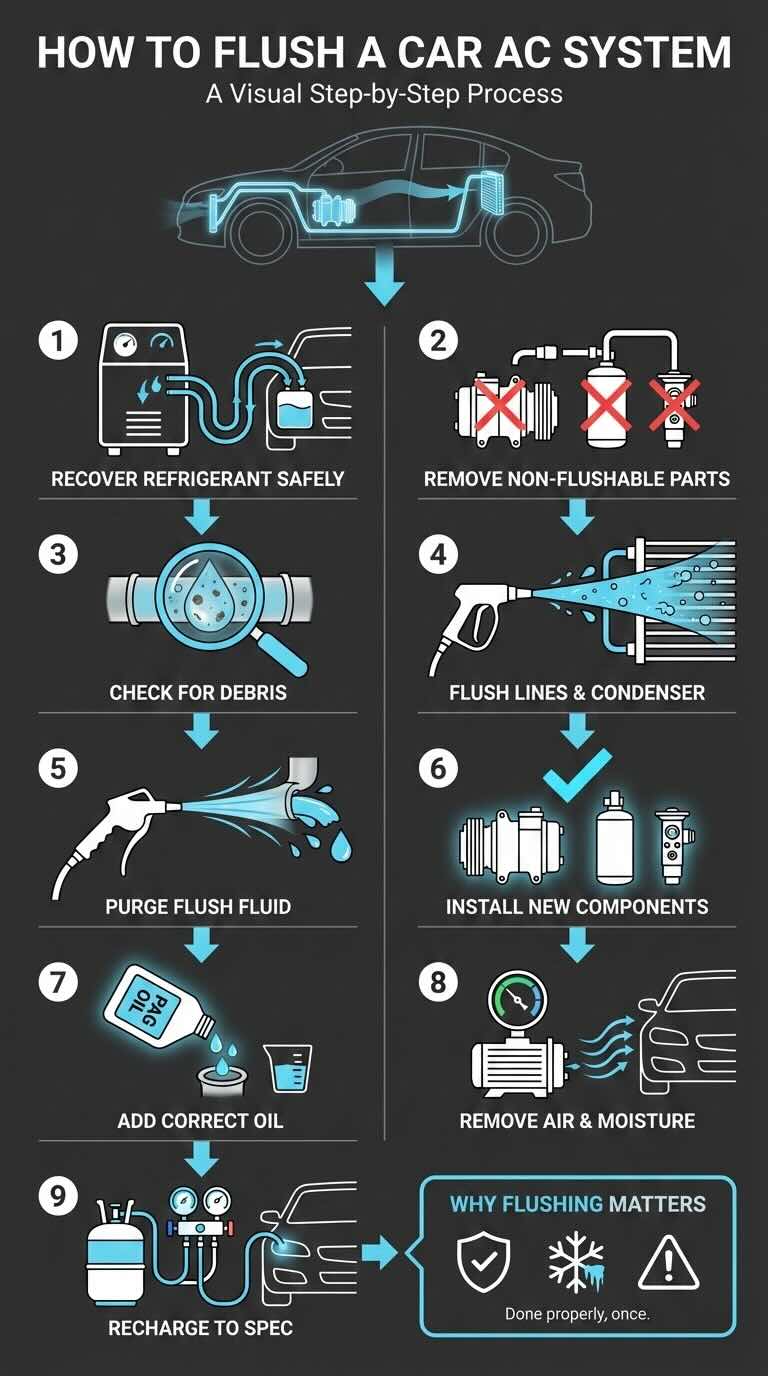
Below is the correct process professionals follow when flushing a car AC system.
Step 1: Recover The Refrigerant Safely
The refrigerant must be professionally recovered using approved equipment. Venting refrigerant to atmosphere is illegal and dangerous.
This step alone requires specialised machines, which is why most DIY attempts stop here.
Step 2: Remove Components That Cannot Be Flushed
Before flushing begins, the following parts are removed:
- Compressor
- Receiver drier or accumulator
- Expansion valve or orifice tube
These parts either trap contamination or cannot be cleaned internally.
Step 3: Inspect The System For Contamination
Technicians inspect oil residue and removed components for:
- Metal shavings
- Black sludge
- Burnt oil smell
If metal debris is present, the condenser may also need replacement rather than flushing.
Step 4: Flush The System Lines And Condenser
Flushing fluid is injected under pressure through the system pipes and condenser.
The fluid flows through, carrying contamination out into a catch container. This process is repeated until the fluid exits clean.
This step may take several cycles on heavily contaminated systems.
Step 5: Blow Out Remaining Flush Fluid
Compressed air or nitrogen is used to remove all remaining flush solvent.
No liquid must remain inside the system. Any leftover solvent can damage seals or mix badly with oil.
Step 6: Replace Removed Components
New components are installed:
- New compressor
- New receiver drier or accumulator
- New expansion valve or orifice tube
Skipping these replacements is one of the most common causes of repeat AC failure.
Step 7: Add The Correct Oil
The correct type and quantity of compressor oil is added based on:
- Vehicle specifications
- Compressor type
- Refrigerant type
Too much or too little oil reduces cooling and shortens compressor life.
Step 8: Vacuum Test The System
A vacuum pump removes air and moisture from the system.
This step usually runs for 30 to 60 minutes. The system is then monitored to ensure it holds vacuum. If it does not, there is a leak.
Step 9: Recharge With Refrigerant
Only after passing vacuum testing is the system recharged with the correct refrigerant weight.
This is a precise measurement, not guesswork.
When Should You Flush a Car AC System?
Not every AC issue requires a flush. In fact, flushing when it is not needed can be a waste of time and money.
A car AC system should be flushed if:
- The compressor has failed or seized
- Metal particles are found in the system
- The system has been open to air for a long time
- The wrong oil or refrigerant was previously used
- There is internal contamination or sludge
A car AC system does not usually need flushing if:
- It just needs a regas
- There is a small refrigerant leak
- The system is cooling fine but smells bad
- You are doing routine maintenance
If your air conditioning is blowing warm air, flushing may be required, but only after proper diagnosis. This is covered in detail in our guide on why a car air conditioner is not getting cold.
Can You Flush A Car AC System Yourself?
Technically, yes. Realistically, most people should not.
DIY flushing is risky because:
- Refrigerant recovery requires licensed equipment
- Incorrect flushing damages components
- Moisture left in the system causes corrosion
- Oil quantities are often guessed incorrectly
Modern systems, especially those using R1234yf refrigerant, are far less forgiving than older designs.
For most vehicles, professional flushing is cheaper than replacing a second compressor.
Common Mistakes When Flushing A Car AC System
These mistakes cause more damage than the original problem.
- Flushing the compressor
- Reusing the old receiver drier
- Skipping vacuum testing
- Using brake cleaner or solvents not designed for AC systems
- Guessing oil quantities
- Recharging without leak testing
Avoiding these mistakes is why experience matters.
How Much Does It Cost To Flush A Car AC System?
Costs vary depending on contamination level and vehicle type.
Typical price ranges in Perth:
- Basic system flush after compressor failure: moderate cost
- Severe contamination with condenser replacement: higher cost
- Luxury, hybrid, or EV systems: higher again
Flushing is often combined with an AC service or regas. You can see typical pricing in our car aircon regas cost guide.
Is Flushing Always Enough After Compressor Failure?
No. In some cases, flushing alone is not sufficient.
If metal debris is widespread:
- Condenser replacement is often required
- Evaporator replacement may be recommended
- All hoses may need inspection
Skipping these steps leads to rapid repeat failure.
Why Professional Experience Matters With AC Flushing
Modern vehicles use tighter tolerances, variable compressors, and newer refrigerants. Small mistakes cause expensive damage.
At Voltaic Auto Electrical, flushing is performed by qualified auto electricians with over 20 years of hands-on experience across standard vehicles, heavy-duty equipment, and modern EV systems .
That experience matters when diagnosing whether flushing is needed at all.
How To Flush A Car AC System Properly
To summarise, how do you flush a car AC system comes down to doing it the right way, not the quick way.
The right way being: let a professional car aircon service team handle the job.
A proper flush:
- Removes contamination fully
- Protects new components
- Restores cooling performance
- Prevents repeat failures
If your AC system has suffered compressor failure or internal contamination, flushing is not optional. It is essential.
If you are unsure whether your system needs flushing or just a service, professional diagnosis will save you money in the long run.